
In J. R. R. Tolkien's fantasy stories, the Ainur are a race of spirits. The Ainur ["Holy Ones", in the ancient Elvish language of Quenya] were the first of the creations of Eru Ilúvatar ['The One Father of All'] out of his thought, who aided in the creation of the world. The few most powerful and greatest of the Ainu are called the "Valar" [powers], the uncountable numbers of others are the "Maiar" [beautiful ones].
in the Timeless Realm, before the world was made, each of the Ainu was taught the art of music. Together, they made the Ainulindalë [Song of the Ainu], called "the Great Music": the story of all creation sung long before the material world was made. Further, each of the Ainu is associated with some element of the world and the Vala that personifies it.
Ainu are shape-shifters. They normally have three forms: one invisible, one like a noble and beautiful elf (because they admire the elves and wish to make them comfortable) and at least one more native form that expresses their purpose in the world. Further shape-shifting is recorded, but not common. While in the world, Ainu are ageless, but can suffer injury and even destruction, when they must revert to bodiless invisible forms.
The Ainu are featured in much of JRR Tolken's "The Silmarillion". The most complete Tolkien description and naming of the countless Maiar is in "The Book of Lost Tales", quoted here as they are leaving the Timeless Realm to create the material world after the Great Music. Translations from Quenya are in [brackets].
-----------------------------------------------------------
[AIR]
Behold, Manwe Súlimo [(good-man) king wind] and Varda [queen] the Beautiful arose. Varda it was who at the playing of the Music had thought much of light that was white and silver and of stars. Those twain gathered now wings of power to themselves and fared swiftly though the three airs…
With them came many of those lesser Vali [powers (also "Valar")] who loved them and had played nigh them and attuned their music to theirs, and these are the Mánir [(good) spirits of the air] and the Súruli [spirits of wind] the sylphs of the airs and of the winds.
[FIRE]
…Now swiftly as they fared, Melko [flame] was there before them, having rushed headlong flaming through the airs in the impetuosity of his speed, and there was a tumult of the sea where he had dived and the mountains above him spouted flames and the earth gaped and rocked; but Manwë beholding this was wroth.
[WATER]
Thereafter came Ulmo and Aulë, and with Ulmo [fluid] were none, save Salmar [harpist] only who was after known as Noldorin [wisdom], for good though the heart of [Ulmo,] that mighty one he thought ever deep thoughts alone, and was silent and aloof and haughty even to the Ainur;
[EARTH]
with Aulë [invention] was that great lady Palúrien [earth-mother] whose delights were richness and fruits of the earth, for which reason has she long been called Yavanna [fruitful] among the Eldar [elves].
About them fared a great host who are the sprites of trees and woods, of dale and forest and mountain-side, or those that sing amid the grass at morning and chant among the standing corn at eve. These are the Nermir [fays of the meads] and the Tavari [fays of the woods], Nandini [fays of the valleys] and Orossi [fays of the mountains], brownies, fays, pixies, leprawns [leprechauns(?)], and what else are they not called, for their number is very great: yet must they not be confused with the Eldar [elves], for they were born before the world and are older than its oldest, and are not of it, but laugh at it much, for had they not somewhat to do with its making, so that it is for the most part a play for them; but the Eldar are of the world and love it with a great and burning love, and are wistful in all their happiness for that reason
[WATER]
Now behind these great chieftains came Falman-Ossë [Surf Maker - Sea Lord]of the waves of the sea and Ónen [Sea Lady] his consort, and with them the troops of the Oarni [sea-dwellers] and Falmaríni [surf-dwellers] and the long-tressed Winglidi [foam-nymphs], and those are the spirits of the foam and the surf of ocean. Now Ossë was a vassal and subordinate to Ulmo, and was so for fear and reverence and not for love.
[SPIRIT]
Behind him came Tulkas Polórëa, [steady might] rejoicing in his strength, and those breathren the Fanturi [spirit masters] Lórien Olofántur, [the Slumber Dream-master] and Vefántur Mandos, [the Doom-master of the Dead], … and the twain who are known as the Tári [Queens] Fui Nienna, [the Weeping Mistress of Death] and Vána Tuivána, [the Ever-Young Mistress of Life]…
-------------------------------------
Thus the fae, mer and furry fit in Tolkien's world as these Ainu when in visible form.
Enjoy your play!
---------------------------------------
ref:
The Book of Lost Tales - One (posthumous) JRR Tolkien, Ed CR Tolkien
copyright (C) 1983, the Estate of JRR Tolkien
The Silmarillion, JRR Tolkien, Ed CR Tolkien
Copyright (c) 1977 by George allen & Unwin Publishers) Ltd,
copyright material quoted under "fair use" rules
Thursday, January 20, 2011

Thursday, January 6, 2011
Valimar
From "the Book of Lost Tales" and "the Silmarillion" chapter "Of the beginning of Days", collected descriptions of Valimar in Valinor in Aman in Eä
"Behind the walls of the Pelóri [mountains] the Valar established their domain in that region which is called Valinor, and there were their houses, their gardens, and their towers. In that guarded land the Valar gathered great store of light and an the fairest things that were saved from the ruin; and many others yet fairer they made anew, and Valinor became more beautiful even than Middle-earth in the Spring of Arda; and it was blessed, for the Deathless dwelt there, and there naught faded nor withered, neither was there any stain upon flower or leaf in that land, nor any corruption or sickness in anything that lived; for the very stones and waters were hallowed.
And when Valinor was full-wrought and the mansions of the Valar were established, in the midst of the plain beyond the mountains they built their city, Valmar of many bells.
"But in the plain in the full radiance of the [Two] trees was a cluster of dwellings built like a fair and smiling town, and that town was named Valmar. No metal and no stone, nor any wood of mighty trees was spared to their raising. Their roofs were of gold and their floors of silver and their doors of polished bronze; they were lifted with spells and their stones were bound with magic."
in Valimar his halls are wide and low, and the skins and pelts of great richness and price are strewn there without end upon the floor or hung upon the walls, and spears and bows and knives thereto. In the midst of each room and hall a living tree grows and holds up the roof, and its bole is hung with trophies and with antlers. Here is all Oromë's folk in green and brown and there is a noise of boisterous mirth, and the lord of forests makes lusty cheer; but Vàna his wife so often as she may steals thence.
The Gardens of Vána were far away from the noise in the Halls of Oromë, fenced stoutly from the wilder lands with whitethorn of great size that blossoms like everlasting snow. Its innermost solitude is walled with roses, and this is the place best beloved of that fair Lady of the Spring. (bolt)
His was a house of mirth and revelry; and it sprang high into the air with many storeys, and had a tower of bronze and pillars of copper in a wide arcade. In its court men played and rivaled one another in doughty feats, and there at times would that fair maiden Nessa wife of
Tulkas bear goblets of the goodliest wine and cooling drinks among the players. But most of all she loves to retire to a place of fair lawns whose turn Oromë her brother had culled for the richest of all his forest glades, and Palúrien had planted it with spells that is was always green and smooth. There danced she among her maidens as long as Laurellin was in bloom, for is she not greater in dance than Vana herself?
"Osse, too had a great house when he tired of the noise of the sea. They brought thousands of pearls for its building and its floors were of sea-water and its tapestries like the glint of silver skins of fishes and it was roofed with foam.
-------------
ref:
The Book of Lost Tales - One (posthumous) JRR Tolkien, Ed CR Tolkien
copyright (C) 1983, the Estate of JRR Tolkien
The Silmarillion, JRR Tolkien, Ed CR Tolkien
Copyright (c) 1977 by George Allen & Unwin Publishers) Ltd,
"Behind the walls of the Pelóri [mountains] the Valar established their domain in that region which is called Valinor, and there were their houses, their gardens, and their towers. In that guarded land the Valar gathered great store of light and an the fairest things that were saved from the ruin; and many others yet fairer they made anew, and Valinor became more beautiful even than Middle-earth in the Spring of Arda; and it was blessed, for the Deathless dwelt there, and there naught faded nor withered, neither was there any stain upon flower or leaf in that land, nor any corruption or sickness in anything that lived; for the very stones and waters were hallowed.
And when Valinor was full-wrought and the mansions of the Valar were established, in the midst of the plain beyond the mountains they built their city, Valmar of many bells.
"But in the plain in the full radiance of the [Two] trees was a cluster of dwellings built like a fair and smiling town, and that town was named Valmar. No metal and no stone, nor any wood of mighty trees was spared to their raising. Their roofs were of gold and their floors of silver and their doors of polished bronze; they were lifted with spells and their stones were bound with magic."
The domains of Oromë & Vána in Valimar:
in Valimar his halls are wide and low, and the skins and pelts of great richness and price are strewn there without end upon the floor or hung upon the walls, and spears and bows and knives thereto. In the midst of each room and hall a living tree grows and holds up the roof, and its bole is hung with trophies and with antlers. Here is all Oromë's folk in green and brown and there is a noise of boisterous mirth, and the lord of forests makes lusty cheer; but Vàna his wife so often as she may steals thence.
The Gardens of Vána were far away from the noise in the Halls of Oromë, fenced stoutly from the wilder lands with whitethorn of great size that blossoms like everlasting snow. Its innermost solitude is walled with roses, and this is the place best beloved of that fair Lady of the Spring. (bolt)
The domains of Tulkas & Nessa in Valimar:
His was a house of mirth and revelry; and it sprang high into the air with many storeys, and had a tower of bronze and pillars of copper in a wide arcade. In its court men played and rivaled one another in doughty feats, and there at times would that fair maiden Nessa wife of
Tulkas bear goblets of the goodliest wine and cooling drinks among the players. But most of all she loves to retire to a place of fair lawns whose turn Oromë her brother had culled for the richest of all his forest glades, and Palúrien had planted it with spells that is was always green and smooth. There danced she among her maidens as long as Laurellin was in bloom, for is she not greater in dance than Vana herself?
The domains of Ossë & Uinen in Valimar:
"Osse, too had a great house when he tired of the noise of the sea. They brought thousands of pearls for its building and its floors were of sea-water and its tapestries like the glint of silver skins of fishes and it was roofed with foam.
-------------
ref:
The Book of Lost Tales - One (posthumous) JRR Tolkien, Ed CR Tolkien
copyright (C) 1983, the Estate of JRR Tolkien
The Silmarillion, JRR Tolkien, Ed CR Tolkien
Copyright (c) 1977 by George Allen & Unwin Publishers) Ltd,
Wednesday, January 5, 2011
The Life and Times of Túna
Once upon a time, there was a little hill named Túna.
Actually, at the beginning of time, when things such as hills and valleys and oceans formed under the influence of the Valar powers, the little hill didn't know it was a "tun" [hill] or would be called "Túna" ["this mound"], or even have much idea (if a hill can have ideas... and I think that it can) of what would become of it and what role history would give it.
But, at this once upon a time, this little hill found itself quite serenely under soft starless skies as the susurrussing sea slowly charmed eastern shore-side stones into soft sands. Perhaps bright things traversed it and the sky and the sea of this one particular little hill, but it was really no different than all the other soft rolling hills stretching easily across a gentle continent, except for being a little smoother and rounder [kor] and a littler nearer the rolling ocean than the other little hills. But things changed nearby much faster than the tides and winds usually change little hills.
First came lights: One by one, little stars [elen] appeared floating in the dark sky, then more and more of them. A sudden flash of light far across the waters to the east glowed then faded almost as soon as it appeared. After a dark time, another, brighter light glowed, but this one shined steady and long. As if they had been waiting for that light, soft green grasses and tiny flowers colored Túna and all the hills and valleys, eager to live and grow with urgency that no hill could ever hope to match. Then, when that bright light went out, the little growing things slowed and stopped growing, in a sleep as deep as hills' sleep under dark skies, moving no more than the stones themselves. But these things were all common for all the little hills across the great wide world
If little hills can have a father (... and I think that they can), that is who seemed to appear next. Father, as hills can sense these things, seemed to be piling hill upon hill upon hill to the west, making a huge craggy fence of mountains running north to south perhaps a league inland from the coast. If a hill feels fear, Túna feared that it would be added to the tremendous mountain range, or that the mountains would fall onto it. But little Túna was untouched. Only the hills deep inland were lifted into the fence [pelo] of mountains [oror] that grew impossibly high, and higher. Pelóri, those mountains would be called.
One of those mountains, south-west yet very near to little Túna, grew taller and yet taller. White snow and ice gathered on its slopes even as it grew. Snow-white [lossë] would color the tallest of that tallest of mountain ranges in all the world, forever [oio]. Mount Ever-white, Oiolossë, it would be called. The tip [tillë] of high [tá] Oiolossë is chilled and pale [ninquë]. That lofty place, highest of all places in the wide world, would be a home to gods. Taníquetil, it would be called.
Even as those lofty mountains rose above little Túna, more and more stars populated the dark sky while the green grass slept. And dark things seemed to travel from the lands north and from the sea east to test and cross the new mountains, but they were unable to penetrate their fence. Those dark things took little notice of Túna and the league-wide strip of land between the mountains and the sea under their feet, since there was nothing there to interest them. Soon they left, some back over the sea, some back to the north and some down the coast to the south.
Again light appeared, but now from the west, behind the mountains, bathing the sky in shifting silver and golden glows. Suddenly, some mountains were cleaved and cast down, and the light burst bright onto little Túna as the light [cala] passed thru the cleft [cilya] out over the hills and the ocean to the lands far to the east. Calacirya, would that pass be called.
Even as the last stone fell, the sleeping grasses awoke and grew anew. And because the light was brighter there, Túna's growing things and those nearby took on a lushness and beauty unseen in the rest of the round wide world. Creatures and animals came and went. Trees and forests grew in that long coastal plain that would soon be called Eldamar, "Elf [elda] - home [mar]"
For, slowly streaming through the eastern ocean, a large lone [eressëa] island [tol], borne in the sea-god's arms and bearing the willing elves seeking the light, approached the shore off the Calacirya and pressed itself into the coast, indenting the shoreline. The eager elves departed the traveling island to see the bright lights, escorted by fae and spirits and gods themselves. Too soon, the lonely island retreated away across the sea, leaving the empty Bay of Eldamar to mark its landing right near little Túna, again untouched by the change in terrain.
Finally, noticing our unusually untouched pretty little hill, as history tells us, "The gods named that hill "Kôr" by reasons of its roundness and its smoothness" " pg 132). On that very site, in view of Manwë's snowy palace on Taníquetil in the majestic Pelorí, and the verdant Eldamar stretching south through unnamed forests and north to what will be called Alqualondë, in the light of the Two Trees through Calacirya, the Noldor elves with king Finwë erected a tower to watch [tir] over the pass and sparkling seas for monsters and the elves yet to come, building finally the greatest of cities there. Tirion, after the watchtower, it would be called.
Much has been written of the beauty and flower of Tirion on Túna, once called "Kôr, the town on the round hill", and even "Kortirion, the ancient town built above the rocks of Eldamar, whence the fairies marched into the world", ("The Book of Lost Tales 1", page 296) and more will be written elsewhere.
But happily (if a hill can be happy ... and I think that it can), the island of Tol Eressëa returned to the Bay of Eldamar, within sight of little Túna, where it is rooted to this very day. And in time, even more little islands scattered themselves like mystic stars up and down the coast, shadowing the seas. And, finally, all those islands and all these lands described here (The Undying Lands, Aman, this land is all called) and those living there were lifted off the wide round world toward the Timeless Realm, where little Túna can still be found.
And they lived happily ever after (if a hill can live...
Actually, at the beginning of time, when things such as hills and valleys and oceans formed under the influence of the Valar powers, the little hill didn't know it was a "tun" [hill] or would be called "Túna" ["this mound"], or even have much idea (if a hill can have ideas... and I think that it can) of what would become of it and what role history would give it.
But, at this once upon a time, this little hill found itself quite serenely under soft starless skies as the susurrussing sea slowly charmed eastern shore-side stones into soft sands. Perhaps bright things traversed it and the sky and the sea of this one particular little hill, but it was really no different than all the other soft rolling hills stretching easily across a gentle continent, except for being a little smoother and rounder [kor] and a littler nearer the rolling ocean than the other little hills. But things changed nearby much faster than the tides and winds usually change little hills.
First came lights: One by one, little stars [elen] appeared floating in the dark sky, then more and more of them. A sudden flash of light far across the waters to the east glowed then faded almost as soon as it appeared. After a dark time, another, brighter light glowed, but this one shined steady and long. As if they had been waiting for that light, soft green grasses and tiny flowers colored Túna and all the hills and valleys, eager to live and grow with urgency that no hill could ever hope to match. Then, when that bright light went out, the little growing things slowed and stopped growing, in a sleep as deep as hills' sleep under dark skies, moving no more than the stones themselves. But these things were all common for all the little hills across the great wide world
If little hills can have a father (... and I think that they can), that is who seemed to appear next. Father, as hills can sense these things, seemed to be piling hill upon hill upon hill to the west, making a huge craggy fence of mountains running north to south perhaps a league inland from the coast. If a hill feels fear, Túna feared that it would be added to the tremendous mountain range, or that the mountains would fall onto it. But little Túna was untouched. Only the hills deep inland were lifted into the fence [pelo] of mountains [oror] that grew impossibly high, and higher. Pelóri, those mountains would be called.
One of those mountains, south-west yet very near to little Túna, grew taller and yet taller. White snow and ice gathered on its slopes even as it grew. Snow-white [lossë] would color the tallest of that tallest of mountain ranges in all the world, forever [oio]. Mount Ever-white, Oiolossë, it would be called. The tip [tillë] of high [tá] Oiolossë is chilled and pale [ninquë]. That lofty place, highest of all places in the wide world, would be a home to gods. Taníquetil, it would be called.
Even as those lofty mountains rose above little Túna, more and more stars populated the dark sky while the green grass slept. And dark things seemed to travel from the lands north and from the sea east to test and cross the new mountains, but they were unable to penetrate their fence. Those dark things took little notice of Túna and the league-wide strip of land between the mountains and the sea under their feet, since there was nothing there to interest them. Soon they left, some back over the sea, some back to the north and some down the coast to the south.
Again light appeared, but now from the west, behind the mountains, bathing the sky in shifting silver and golden glows. Suddenly, some mountains were cleaved and cast down, and the light burst bright onto little Túna as the light [cala] passed thru the cleft [cilya] out over the hills and the ocean to the lands far to the east. Calacirya, would that pass be called.
Even as the last stone fell, the sleeping grasses awoke and grew anew. And because the light was brighter there, Túna's growing things and those nearby took on a lushness and beauty unseen in the rest of the round wide world. Creatures and animals came and went. Trees and forests grew in that long coastal plain that would soon be called Eldamar, "Elf [elda] - home [mar]"
For, slowly streaming through the eastern ocean, a large lone [eressëa] island [tol], borne in the sea-god's arms and bearing the willing elves seeking the light, approached the shore off the Calacirya and pressed itself into the coast, indenting the shoreline. The eager elves departed the traveling island to see the bright lights, escorted by fae and spirits and gods themselves. Too soon, the lonely island retreated away across the sea, leaving the empty Bay of Eldamar to mark its landing right near little Túna, again untouched by the change in terrain.
Finally, noticing our unusually untouched pretty little hill, as history tells us, "The gods named that hill "Kôr" by reasons of its roundness and its smoothness" " pg 132). On that very site, in view of Manwë's snowy palace on Taníquetil in the majestic Pelorí, and the verdant Eldamar stretching south through unnamed forests and north to what will be called Alqualondë, in the light of the Two Trees through Calacirya, the Noldor elves with king Finwë erected a tower to watch [tir] over the pass and sparkling seas for monsters and the elves yet to come, building finally the greatest of cities there. Tirion, after the watchtower, it would be called.
Much has been written of the beauty and flower of Tirion on Túna, once called "Kôr, the town on the round hill", and even "Kortirion, the ancient town built above the rocks of Eldamar, whence the fairies marched into the world", ("The Book of Lost Tales 1", page 296) and more will be written elsewhere.
But happily (if a hill can be happy ... and I think that it can), the island of Tol Eressëa returned to the Bay of Eldamar, within sight of little Túna, where it is rooted to this very day. And in time, even more little islands scattered themselves like mystic stars up and down the coast, shadowing the seas. And, finally, all those islands and all these lands described here (The Undying Lands, Aman, this land is all called) and those living there were lifted off the wide round world toward the Timeless Realm, where little Túna can still be found.
And they lived happily ever after (if a hill can live...
Sunday, December 12, 2010
Oromë and the Great March
Oromë and the Great March Timeline
1085 : Oromë discovers the Elves. Melkor breeds Orcs.
1092 - 1099 : The Valar [Powers] protect the Elves and battle Melko.
--------------------------------
Silmarillion quotes:
1085 : Oromë discovers the Elves. Melkor breeds Orcs.
1092 - 1099 : The Valar [Powers] protect the Elves and battle Melko.
1100: The Valar raize Utumno and chain Melkor, now doomed to spend 300 Valinorean years confined in the Halls of Mandos.
1101 The Valar summon the elves to Valinor.
1102 the Vala Oromë escorts Ingwë, Finwë, and Elwë to Valinor.
1104 The Three return to convince many elves to follow them to Valinor.
1105 The Great March begins. The Avari [the Unwilling] stay behind.
c. 1110 Awakening of the Dwarves.
1115 The Eldar [marchers]reach Anduin the Great and the Hithaeglir (Misty Mountains)
--------------------------------
Silmarillion quotes:
Oromë tamer of beasts would ride too at whiles in the darkness of the unlit forests; as a mighty hunter he came with spear and bow, pursuing to the death the monsters and fell creatures of the kingdom of Melkor, and his white horse Nahar shone like silver in the shadows. Then the sleeping earth trembled at the beat of his golden hooves, and in the twilight of the world Oromë would sound the Valaróma his great horn upon the plains of Arda; whereat the mountains echoed, and the shadows of evil fled away, and Melkor himself quailed...
And on a time it chanced that Oromë rode eastward in his hunting, and he turned north by the shores of Helcar and passed under the shadows of the Orocarni, the Mountains of the East. Then on a sudden Nahar set up a great neighing, and stood still. And Oromë wondered and sat silent, and it seemed to him that in the quiet of the land under the stars he heard afar off many voices singing.
Thus it was that the Valar found at last, as it were by chance, those whom they had so long awaited. And Oromë looking upon the Elves was filled with wonder, as though they were beings sudden and marvellous and unforeseen; for so it shall ever be with the Valar. From without the World, though all things may be forethought in music or foreshown in vision from afar, to those who enter verily into EÄ each in its time shall be met at unawares as something new and unforetold.
In the beginning the Elder Children of Illúvatar were stronger and greater than they have since become; but not more fair, for though the beauty of the Quendi in the days of their youth was beyond all other beauty that Illúvatar has caused to be, it has not perished, but lives in the West, and sorrow and wisdom have enriched it. And Oromë loved the Quendi, and named them in their own tongue Eldar, the people of the stars; but that name was after borne only by those who followed him upon the westward road.
Yet many of the Quendi were filled with dread at his coming; and this was the doing of Melkor. For by after-knowledge the wise declare that Melkor, ever watchful, was first aware of the awakening of the Quendi, and sent shadows and evil spirits to spy upon them and waylay them. So it came to pass, some years ere the coming of Oromë, that if any of the Elves strayed far abroad, alone or few together, they would often vanish, and never return; and the Quendi said that the Hunter had caught them, and they were afraid. And indeed the most ancient songs of the Elves, of which echoes are remembered still in the West, tell of the shadow-shapes that walked in the hills above Cuiviénen, or would pass suddenly over the stars; and of the dark Rider upon his wild horse that pursued those that wandered to take them and devour them. Now Melkor greatly hated and feared the riding of Oromë, and either he sent indeed his dark servants as riders, or he set lying whispers abroad, for the purpose that the Quendi should shun Oromë, if ever they should meet.
Thus it was that when Nahar neighed and Oromë indeed came among them, some of the Quendi hid themselves, and some fled and were lost. But those that had courage, and stayed, perceived swiftly that the Great Rider was no shape out of darkness; for the light of Aman was in his face, and all the noblest of the Elves were drawn towards it....
Oromë tarried a while among the Quendi, and then swiftly he rode back over land and sea to Valinor and brought the tidings to Valmar; and he spoke of the shadows that troubled Cuiviénen. Then the Valar rejoiced, and yet they were in doubt amid their joy; and they debated long what counsel it were best to take for the guarding of the Quendi from the shadow of Melkor. But Oromë returned at once to Middle-earth and abode with the Elves...
Elves were at first unwilling to hearken to the summons [to Aman], for they had as yet seen the Valar only in their wrath as they went to war, save Oromë alone; and they were filled with dread. Therefore Oromë was sent again to them, and he chose from among them ambassadors who should go to Valinor and speak for their people; and these were Ingwë, Finwë and Elwë, who afterwards were kings. And coming they were filled with awe by the glory and majesty of the Valar, and desired greatly the light and splendour of the Trees. Then Oromë brought them back to Cuiviénen, and they spoke before their people, and counselled them to heed the summons of the Valar and remove into the West...
Long and slow was the march of the Eldar into the west, for the leagues of Middle-earth were uncounted, and weary and pathless. Nor did the Eldar desire to hasten, for they were filled with wonder at all that they saw, and by many lands and rivers they wished to abide; and though all were yet willing to wander, many feared rather their journey's end than hoped for it Therefore whenever Oromë departed, having at times other matters to heed, they halted and went forward no more, until he returned to guide them. And it came to pass after many years of journeying in this manner that the Eldar took their course through a forest, and they came to a great river, wider than any they had yet seen; and beyond it were mountains whose sharp horns seemed to pierce the realm of the stars. This river, it is said, was even the river which was after called Anduin the Great, and was ever the frontier of the west-lands of Middle-earth. But the mountains were the Hithaeglir, the Towers of Mist upon the borders of Eriador; yet they were taller and more terrible in those days, and were reared by Melkor to hinder the riding of Oromë. Now the Teleri abode long on the east bank of that river and wished to remain there, but the Vanyar and the Noldor passed over it, and Oromë led them into the passes of the mountains. And when Oromë was gone forward the Teleri looked upon the shadowy heights and were afraid....
...
As I recount in the Lay of the Last, the Teleri sunder themselves several times in the journey across Middle-Earth. Oromë yet guides the three tribes beyond those mountains from land to land toward the sea. Once at the shores though, Oromë passes leadership of the Elves to the Sea-ruler, Ulmo, and his vassal, Ossë, while he still protects them, as he will through all time:
In Beleriand still at times rode Oromë the great, passing like a wind over the mountains, and the sound of his horn came down the leagues of the starlight, and the Elves feared him for the splendour of his countenance and the great noise of the onrush of Nahar; but when the Valaróma echoed in the hills, they knew well that all evil things were fled far away.
Saturday, December 11, 2010
Oromë
While the Silmarillion does not mention it, the Book of Lost Tales grants Aulë and Yavanna two Valar children: Oromë and Nessa. Oromë plays a large role in the early development of the elves in every version, serving as their guide on the Great March.
Silmarillion reads thus:
Oromë is a mighty lord. If he is less strong than Tulkas, he is more dreadful in anger; whereas Tulkas laughs ever, in sport or in war, and even in the face of Melkor he laughed in battles before the Elves were born. Oromë loved the lands of Middle-earth, and he left them unwillingly and came last to Valinor; and often of old he passed back east over the mountains and returned with his host to the hills and the plains. He is a hunter of monsters and fell beasts, and hedelights in horses and in hounds; and all trees he loves, for which reason he is called Aldaron, and by the Sindar Tauron, the Lord of Forests. Nahar is the name of his horse, white in the sun, and shining silver at night.

The Valarôma is the name of his great horn, the sound of which is like the upgoing of the Sun in scarlet, or the sheer lightning cleaving the clouds. Above all the horns of his host it was heard in the woods that Yavanna brought forth in Valinor; for there Oromë would train his folk and his beasts for the pursuit of the evil creatures of. Melkor. The spouse of Oromë is Vâna, the Ever-young; she is the younger sister of Yavanna. All flowers spring as she passes and open if she glances upon them; and all birds sing at her coming.
Images:
http://i20.photobucket.com/albums/b244/koiduonu/LotR/Orome.jpg
http://img-fan.theonering.net/rolozo/images/gondron/OromeSm.jpg
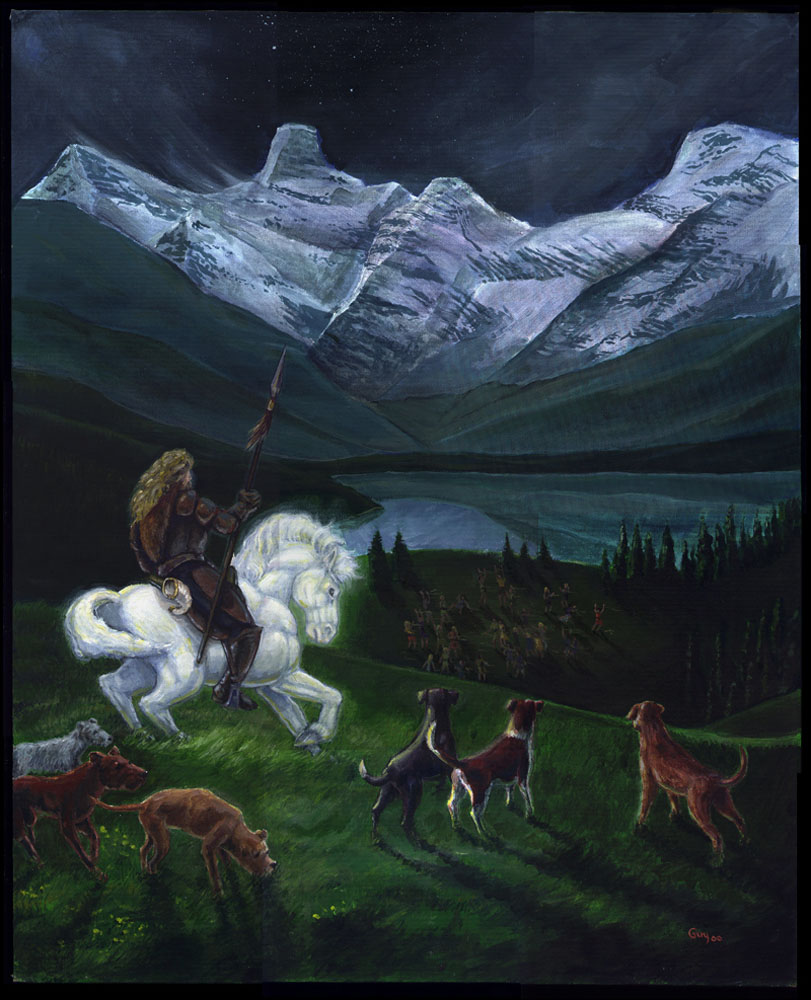
http://www.elfwood.com/art/a/n/anke/orome_elf.jpg

http://images4.wikia.nocookie.net/__cb20080701211958/lotr/images/d/d9/Orome.jpg
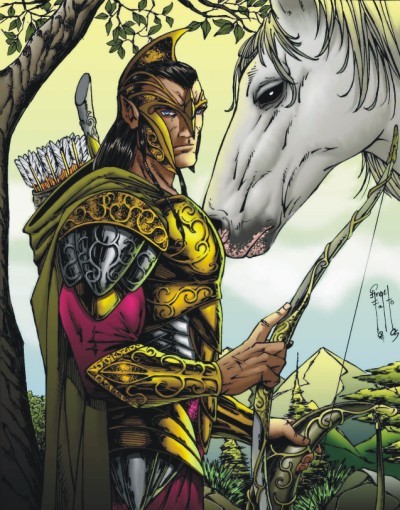
http://lotr.wikia.com/wiki/Orom%C3%AB
Oromë (Quenya Tengwar: `N7Yt$; IPA: [ˈorome]; from the Valarin Arômêz) is a Vala. His name is sometimes said to mean Loud Trumpeter in Quenya but the Valarin form is a name without meaning. He is also known as Aldaron, Araw, Béma, Tauron, The Huntsman of the Valar, the Great Rider, and Lord of Forests. He is the brother of Nessa and the husband of Vána.
During the Years of the Trees, after most of the Valar had withdrawn completely from Middle-Earth and hidden themselves in Aman, Oromë still hunted in the forests of Middle-Earth on occasion. Thus, he was responsible for finding the elves when they awoke at Cuivienen, and the first to name them the Eldar. Being a powerful huntsman, he was active in the struggles against Morgoth. He has a great horn (the Valaróma) and a great steed (Nahar).
... two of the five wizards, who were called in Valinor Alatar and Pallando were Maiar sent by Oromë to Middle-Earth. What became of them is not known, although apparently they journeyed into the east with Saruman but did not return. The evidence concerning their fates is discussed in Unfinished Tales.
Oromë has even more in the "Book of Lost Tales - One"
from The Book of Lost Tales - One (posthumous JRRT, Ed CRT.)
copyright 1983 (Del Rey Publications)
Page 66
Oromë the hunter who is named Aldaron king of forests, who shouts for joy upon mountain-tops and is nigh as lusty as that perpetual youth Tulkas. Oromë is the son of Aulë and Palùrien.
Page 76
in Valimar his halls are wide and low, and the skins and fells of great richness and price are strewn there without end upon the floor or hung upon the walls, and spears and bows and knives thereto. In the midst of each room and hall a living tree grows and holds up the roof, and its bole is hung with trophies and with antlers. Here is all Oromë's folk in green and brown and there is a noise of boisterous mirth, and the lord of forests makes lusty cheer; but Vàna his wife so often as she may steals thence.
a tiny footnote on what one can learn from Oromë:
Often [Fëanor and his sons] were guests in the halls of Aulë; but Celegorm went rather to the house of Oromë, and there he got great knowledge of birds and beasts, and all their tongues he knew.
VANA
The spouse of Oromë is Vána, the Ever-young; she is the younger sister of Yavanna. All flowers spring as she passes and open if she glances upon them; and all birds sing at her coming (Sil)
The Gardens of Vána were far away from the noise in the Halls of Oromë, fenced stoutly from the wilder lands with whitethorn of great size that blossoms like everlasting snow. Its innermost solitude is walled with roses, and this is the place best beloved of that fair Lady of the Spring.(bolt)
JRR Tolkien mentions very little of Vána in context of the Elves, but does give her one more relative, from "The Book of Lost Tales" Appendix: Nielíqui is the daughter of Oromë and Vána.
"There sang Amillo joyously to his playing, Amillo who is named Omar, whose voice is the best of all voices, who knoweth all songs in all speeches; but whiles if he sang not to his brothers harp then would he be trilling in the gardens of Oromë when after a time Nielíqui, little maiden, danced about its woods."
A very tight family, these six Valar:
Aulë (Earth) esposes Yavanna (Nature), and they raise Oromë and Nessa.
Yavanna's young sister, Vana, (Youth) espouses Oromë (Travel).
In time, Nessa (Dance) weds Tulkas (Strength), the first recorded marriage in Arda.
In times of trouble, Tulkas and Oromë are the first to action.
In all times, Yavanna and Oromë are wander the world.
These six, with familial affection, cooperate (or not) in the making of the natural world as The One intended.
Friday, October 22, 2010
Noldor in Aman Timeline
This time-line focuses on the Noldor in Aman. This portion of history is 3500 years after the creation of the world that is: Eä. A year in this age was between nine and ten sun-years long.
The Age of the Two Trees in Valinor
and
The Age of the Stars in Middle-Earth
and
The Age of the Stars in Middle-Earth
0: The Valar create the Two Trees of Light, Telperion the Elder and Laurelin the Younger.
c.500: Aulë and Yavanna create and the hibernate the Dwarves and Ents.
1050 : Varda finishes the star-making by kindling the Sickle of the Gods.
The Elves awake in Cuiviénen. Melkor discovers and harasses them.
1085 : Oromë discovers the Elves. Melkor breeds Orcs.
1092 - 1099 : The Valar [Powers] protect the Elves and battle Melko.
1100: The Valar raize Utumno and chain Melkor, now doomed to spend 300 Valinorean years confined in the Halls of Mandos.
1101 The Valar summon the elves to Valinor.
1102 the Vala Oromë escorts Ingwë, Finwë, and Elwë to Valinor.
1104 The Three return to convince many elves to follow them to Valinor.
1105 The Great March begins. The Avari [the Unwilling] stay behind.
c. 1110 Awakening of the Dwarves.
1115 The Eldar [marchers]reach Anduin the Great and the Hithaeglir (Misty Mountains)
1125 Awakening of the Ents. The Vanyar and Noldor reach Beleriand.
1128 The Teleri re-join the other Eldar in Beleriand.
1130 Melian enchants and detains Thingol (Elwë) in Nan-Elmoth.
1132 The Vanyar and Noldor travel over the western sea with Ulmo on Tol Eressëa
1133 - 1140 The Vanyar and Noldor arrive in Aman. They build Tirion upon Tùna and the Tower of Ingwë. The Vanyar begin to settle Valmar.
1142 Yavanna gives the Noldor in Tirion the White Tree Galathilion from Telperion.
1149 Ulmo returns to Middle-earth to bring the Teleri to Aman, but Ossë persuades some to remain in West Beleriand (Falas) to become the first mariners, having Cìrdan as Lord.
1150 - 1151 The Teleri travel overseas west from Beleriand with Ossë on Tol Eressëa.
1152 Thingol awakes from the trance, marrying Melian.
1161 Ossë teaches the Teleri the art of shipbuilding, who travel to Valinor.
The Noontide of Valinor
1162 Olwë, the Teleri, and the Noldor begin building Aqualondë.
1165 The last Vanyar depart Tirion for Valmar.
1179 Mùriel births Féanor, then departs to the Halls of Mandos. The House of Finwë discovers earth-gems, and devises tools for their cutting and shaping. Noldo Rùmil devises letters.
1189 Finwë takes Indis, Ingwë's sister, as second wife.
1190 Indis births Fingolfin.
1200 Melian births Lùthien.
1229 Fëanor marries Nerdanel.
1230 Indis births Finarfin. Nerdanel births Maedhros.
1240 Fingolfin weds Anairë.
1245 Anairë births Fingon.
1250 Fëanor revises Rùmil's letters, creating the Tengwar script.
Dwarves enter Ered Luin mountains and found Nogrod and Belegost.
1280 Finarfin weds Eärwen, daughter of Olwë.
1300 Anairë births of Turgon. Eärwen births Finrod. Sindarin lore-master Daeron designes his Runes. Dwarves and elves build Menegroth of the Thousand Caves.
1320 Menegroth is fortified against wolves and other evil creatures roaming Beleriand.
1330 The first orcs invade Beleriand.
1350 Denethor and the Nandor come to Beleriand and settle in Ossiriand.
1362 Eärwen births Galadriel.
c. 1400 Dwarf Durin founds Khazad-dùm.
1400 Melkor is unchained under Tulkas' guardianship.
1410 Manwë gives Melkor freedom within Valinor. Melkor feigns love for the Eldar, teaching and lying to precipitate disputes between Fëanor and Fingolfin.
1449 - 1450 Fëanor constructs the Three Silmarils, enclosing the Lights of the Two Trees.
1450 - 1490 Melkor raises further dissension, teaching sword-making among the Noldor. Fëanor and Fingolfin quarrel. Many Noldor divide their allegiances and forge weapons in secret.
1490 Fëanor threatens Fingolfin at swordpoint. The Valar banish Fëanor from Tirion for 12 years. Finwë and Fëanor's sons also leave Tirion to build Formenos secretly in the North. Fingolfin is regent in Tirion. Known fomentor Melkor eludes the Valar.
1492 Fëanor rebuffs Melkor's parley in Formenos, naming him 'Morgoth Bauglir' [Black Foe].
The Darkening of Valinor
1493 Melkor seeks and finds the monstrous Ungoliant in southern Aman.
1495 Melkor and Ungoliant fatally poison the Two Trees. Melkor kills Finwë and steals the Silmarils. Melkor and Ungoliant flee across the Helcaraxë, battling and separating at Lammoth. Melkor, shape-trapped as the Tyrant of Utumno, regains Angband.
Many Noldor revolt with Fëanor to leave Tirion, battling the Teleri in Alqualondë [the First Kinslaying], then sailing to Middle-earth and burning the swan-ships of the Teleri at Losgar.
1496 Mandos utters of the Prophecy of the North and the Doom of the Noldor.
Repentant Finarfin returns to Tirion, there to rule the remnant of the Noldor in Aman.
1497 Melkor invades Beleriand. Orcs slay Denethor. Melian raises The Girdle around Doriath.
1498 Fëanor and the Noldor attack Melkor in Angband to recover the Silmarils. Balrogs slay Fëanor, Maedhros is captured. Fingolfin and his tribe march over the Helcaraxë to Middle Earth.
The Second Spring of Arda:
The First Age of the Sun and Moon
1500 Aulë and the Valar prepare the Moon and the Sun from the last Silver Flower of Telperion and the last Golden Fruit of Laurelin.The Moon rises, crossing the sky seven times before the rising of the Sun.
This able time-line is borrowed and abridged from the Tolkien Forums
Saturday, October 2, 2010
Estë and Lórien
Like Aulë [meaning "invention" in Quenya] is pronounced rather like "Owl Lay", Estë [meaning Repose, Rest"] sounds a bit like "Ess Stay"
While I think of it, Lothlorien, where dwelt Galadriel in Middle-Earth in Lord of the Rings, is a wholly different place than Lorien. I'll end with a story that ties Noldor Elves to Lórien, when Míriel [Jewel-woman], Fëanor's mother and the first wife of the Noldor King Finwë, made the Gardens her final resting place.
Estë, the gentle, healer of hurts and of weariness, is Irmo's spouse. Grey is her raiment; and rest is her gift. She walks not by day, but sleeps upon an island in the tree-shadowed lake of Lórellin [Dream-lake].
J.R.R Tolkien uses the lovely word "Fëanturi" to mean "masters of spirits" to describe two Valar brothers named Námo [Judge] and Irmo [Desire]. They are usually called Mandos and Lórien, after their domains, the Halls of Mandos [safe-keep] where dead spirits go, and the Gardens of Lórien [Dream-land].
Irmo the younger is the master of visions and dreams. In Lórien are his gardens in the land of the Valar, and they are the fairest of all places in the world, filled with many spirits. From the fountains of Irmo and Estë, all those who dwell in Valinor draw refreshment; and often the Valar come themselves to Lórien and there find repose and easing of the burden of Arda.
This is almost every quote describing to these two characters, the Lord and Lady of Dreams, masters of desire, illusion and healing. While there is minimal description of Estë and no description at all of Irmo (what does a dream look like?), the Gardens of Lórien gets a few more examples:
When [Tillion of the Ainu] would rest he forsook the woods of Oromë, and going into Lórien he lay in dream by the pools of Esté, in Telperion's [the Silver Tree's] flickering beams
Varda, Queen of Skies, later appointed Tillion as the driver of the Moon, ordered to continually circle the sky beside the sun. By driving erratically, he irked the Sun-maid into burning him and the earth some. Estë and Irmo have a part of making peace.
Because of the waywardness of Tilion, therefore, and yet more because of the prayers of Lórien and Esté, who said that sleep and rest had been banished from the Earth, and the stars were hidden, Varda changed her counsel, and allowed a time wherein the world should still have shadow and half-light.
While I think of it, Lothlorien, where dwelt Galadriel in Middle-Earth in Lord of the Rings, is a wholly different place than Lorien. I'll end with a story that ties Noldor Elves to Lórien, when Míriel [Jewel-woman], Fëanor's mother and the first wife of the Noldor King Finwë, made the Gardens her final resting place.
In the bearing of her son, Míriel was consumed in spirit and body; and after his birth she yearned for release from the labours of living. ... when Míriel languished still, Finwë sought the counsel of Manwë, and Manwë delivered her to the care of Irmo in Lórien.There is some grief at Míriel's departure and exhaustion, then,
She went then to the gardens of Lórien and lay down to sleep; but though she seemed to sleep, her spirit indeed departed from her body, and passed in silence to the halls of Mandos. The maidens of Estë tended the body of Míriel, and it remained unwithered; but she did not return. Then Finwë lived in sorrow; and he went often to the gardens of Lórien, and sitting beneath the silver willows beside the body of his wife he called her by her names. But it was unavailing; and alone in all the Blessed Realm he was deprived of joy. After a while he went to Lórien no more.
Subscribe to:
Posts (Atom)