Saturday, April 23, 2011

Dawn of the Fourth Age - "Aule in Mandos"

When asked by the RP leaders in Second Life's "Dawn of the Fourth Age" RP why Aulë didn't appear in Alqulaondë more often, the obvious answer is that Aulë bases out of distant Valimar. When asked to provide an RP regarding what he'd been doing, I wrote something they liked well enough to post to their blogspot site with no changes at all (a rarity, I'm told). Disappointingly for me, they chose to have others continue the the story arc without my input. Good luck to them.

---------------------------------------------------

This letter is carried by a maia in the form of a badger:

"To the High King of Arda, Manwë Sulímo
A letter from Aulë Talka Marda
Written in the Halls of Mandos, the ancient secret cells of Melko,
On this Spring Equinox of the year eleven of the fourth Age of the Sun and Moon

My dearest Lord High King, Aratar and Brother in the will of Eru Ilúvatar:

It is with regret that I find myself detained interminably in the duty of enlarging the Halls of the Dead in anticipation of the armies of the dead that would arrive here at the passing of the Third Age. Although I am weary of this work, I sending this letter at my first opportunity to explain my prolonged absence and request your further forbearance in the completion of my duties.

My duty is ever to oversee, if not construct personally, the major works and domains of the Vala in the World and the immortal souls that dwell there, and this project no less than others has occupied my thought and energies these many long months. A great deal of the needed space has already been hollowed and finished, nearly enough to accommodate all anticipated need for the next few centuries.


Now the trap of Melko, who dwelt for three long ages here in the Halls of Mandos, has sprung on me. He, while here, was not idle: he left what I can only describe as arcane and obscene graffiti on the dark walls and stones deeps around the perimeter of the caverns of the dead, hidden through four long ages until I and my people discovered the beginnings of them while enlarging the Halls. Some of these diagrams and paragraphs, scrawled in Black Speech, in Valarin, in Quenya and Sindarin and Common tongue, and even, frighteningly, in Khuzdul, describe horrible procedures and rituals for making natural beasts into fell creatures, for subverting fair plant-life into poisonous abominations, for devising destructive energies both physical and magical and emotional torments to break the sane mind. Some appear to be insane and demonic raving. Some are taunts written to me by name. Some are potent wards and spells that catch and bend the mind and body and spirit of those who happen on them.

These dark magics Melko left here are most dangerous and strong. On unexpectedly finding and opening these secret cells and the magics therein, six Maiar were quite badly damaged by the energies unleashed on the opening of the wards: those I sent with escort to the Lake of Estë to rest and recover. Three were rendered insane: those I sent with an escort to the Gardens of Lorien to find peace and calm. I dismissed almost all of the Maiar who aid me in this excavation and stone work in the Halls. The remainder I sent to complete the small remaining work of finishing the new Halls extension, then resume their duties in Valinor. There is some secrecy among us about this discovery, but a secret known to more than three is no secret, therefore I asked no oath of them for silence, only their wisdom in sharing what they know.

After hiding the entries to Melko's cell in Mandos, so that none of the wandering ghosts or spirits nearby will happen here, I and only two of the most magically adept Maia in my service are slowly and carefully dispelling the runes and enchantments we find, and wiping away the danger in the walls of the old cells of Melko in Mandos. The magics sometimes surprise me in the strength and subtlety, but I take grim satisfaction in seeing them dissected and dismantled one by one. We are carefully recording what Melko wrote and devised, for whatever else he is, he is clever and subtle. This prolongs the time it will take us to cleanse them all before we vacate this place for it is too fraught with peril until this work is done, thus I am effectively trapped and cannot anticipate the end of it since Melko spent many long idle years creating this ghastly and abominable testament.

Further, I must confess to you now, my Lord, that your brother Melko anticipated that I would be among those who found these writings, and his writings to me personally do pierce my heart. In example, there is one long quarto laying at my feet the troubles of the Noldor: He writes that my dealings with the Noldor was detrimental to them, that my attitude of teaching the most willing while neglecting the unwilling cultivated elitism among them, that my favoritism of some among them harbored alienation among them, that my teaching metallurgy directly brought about the Banishment of Fëanor and therefore the Kinslaying of the Teleri Elves of Alqualondë, that my renouncing my love for them separated them from the Vala who would aid them in Middle Earth, that they would be better and truer Children of Iluvatar had I not meddled in their affairs, that I did a fine job of molding them to be haughty and dangerous, nearly as well as he might have himself. These are clever deceit and false causation in sooth, but also in sooth these echo some of the fears in my own heart. Even now how can I face the Noldor who have returned to Aman when I forswore my friendship and patronage to them in ages past? I would not treat them with enmity, but my heart is broken still, and I cannot face those I once called "Aulendil". I am uneager to walk under the sun or moon or stars of Aman yet for my heart is too heavy for now.

Now I know that I am missed and loved in Aman and I miss these dear ones also. Yavanna or any of the Valar or Maiar would rush to aid me and even dwarves and elves also at even a hint of my request and need but I would not wish this. You know that this news will dismay many into pointless turmoil and rash actions, thus I must invoke your circumspection regarding it, if you will. I fear that even this outcome, of either isolating myself from my loved ones or placing them in peril, is one that Melko devised as an energy draining and time-consuming, delayed and poignant revenge on me for his own chains. It is only a matter of some finite time, though, before this, my fated work, is done and well done.

In the meanwhile, I pray and request that you will advise me as you will. The maia bearing this letter knows the way to me, and can return safely to me on your order. I further pray that you will find some way to relay something of my situation without alarming those we love, and to convey my best wishes and hopes for a speedy return to those who care for me.

I remain ever yours, in the building of Arda,
Aulë Talka Marda

Wednesday, April 13, 2011

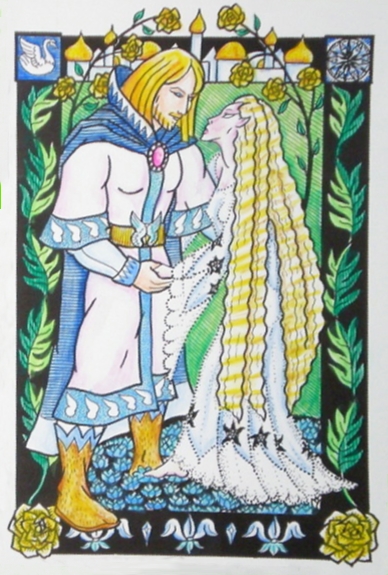
High Elvish marriage

Researching High Elvish weddings is a relatively fruitless task. JRR Tolkien's trilogy and Hobbit contain none of them. The Silmarillion, often detailed, give no details at all about ceremony. "While still in his early youth, [Fëanor] married Nerdanel" is about the longest Elvish description you will find. The only Valar wedding described is thus:

Now it came to pass that while the Valar rested from their labors, and watched the growth and unfolding of the things that they had devised and begun, Manwë ordained a great feast; and the Valar and all their host came at his bidding...
And it is sung that in that feast of the Spring of Arda, Tulkas espoused Nessa the sister of Oromë, and she danced before the Valar upon the green grass of [the island] Almaren.
Then Tulkas slept, being weary and content.
One unusual wedding website quotes extensively from a "Morgoth's Ring" chapter: "Laws and Customs among the Eldar"
"At the end of the feast the betrothed stood forth, and the mother of the bride and the father of the bridegroom joined the hands of the pair and blessed them. For this blessing there was a solemn form, but no mortal has heard it; though the Eldar say that Varda was named in witness by the mother and Manwë by the father; and moreover that the name of Eru was spoken (as was seldom done at any other time). The betrothed then received back one from the other their silver rings (and treasured them); but they gave in exchange slender rings of gold, which were worn upon the index of the right hand.

Also, among the Noldor, it was a custom that the bride's mother should give to the bridegroom a jewel upon a chain or collar; and the bridegroom's father should give a like gift to the bride. These gifts were sometimes given before the feast. "

I extract these elements from the entire quoted text:

Courtship
♥ usually with familial approval
♥ sometimes since childhood
♥ no pre-marital conjugation

Handfasting
♥ in early adulthood, soon after age 50
♥ the father physically giving the daughter's hand to the groom
♥ the families announce betrothal.
♥ the two exchange silver rings
♥ handfasting lasts one year at least, often much longer.


The return of the rings signals revocation of intent to wed. Recall "one year" in age of the Trees is about 9.5 sun-years, so that is a nice long hand-fasting. In modern parlance, the "engagement" is similar: a time where the couple and their families learn to deal with each other and a large project of arranging the wedding celebration itself.


Marriage Ceremony
♥ brides mother and grooms father join the couple's hands.
♥ those parents bless them, solemnly invoking Manwë, Varda and Ilúvatar
♥ the silver rings are returned to one another
♥ gold rings are exchanged

Júli meldanyan, cuilenya ar melmenya
'To Juli my beloved, my life and my love'

The Wedding Feast
♥ occurs before or around the ceremony
♥ the king and/or father usually presides
♥ jewel and jewelry gifts are given to the couple
♥ food and music and dancing and vast attendance

♥ then sleeping happens and life goes on.

Now, to locate some elvish "solemn form blessings" to make a ceremony.

May It Be

Before releasing the 2001 "The Lord of the Rings", director Peter Jackson asked Enya to write and sing a song for soundtrack. Thrilled at the prospect, Enya headed to New Zealand to see the preliminary edits of the film.


May it be;

May it be an evening star Shines down upon you
May it be when darkness falls Your heart will be true
You walk a lonely road Oh! How far you are from home

Mornie utúlië (Quenya: darkness has come)
Believe and you will find your way
Mornie alantië (Quenya: darkness has fallen)
A promise lives within you now

May it be the shadows call Will fly away
May it be you journey on To light the day
When the night is overcome You may rise to find the sun

Mornie utúlië (Quenya: darkness has come)
Believe and you will find your way
Mornie alantië (Quenya: darkness has fallen)
A promise lives within you now

A promise lives within you now


Enya worked with long-time collaborators. Roma Ryan, her lyricist. Nicky Ryan produced, arranged, and managed while Roma Ryan wrote the lyrics. They recorded the song through Enya’s contract with Warner Music in the Ryans’ Dublin studio, Aigle Studio. Like most of Enya’s music "May it Be" is classified as New Age.


Enya performed her song at the Academy Awards on March 24, 2002. She was “absolutely” excited about the performance. For her it was the “first time to be nominated, and to get to perform, it’s just wonderful, absolutely wonderful.”


Human - Elvish Marriage


JRR Tolkien seems to enjoy the theme of mortal man to elf-maid romances leading to marriage. His wife's grave even bears one of these names.

After many alliances in battle and peace, Tuor (a human prince) and Idril (an elven princess) are married by King Turgon (Idril's father) and the entire city celebrates in an early draft. In the final Silmarillion, JRRT only celebrates them with a feast thus:

"the heart of Idril was turned to him, and his to her... So high did Tuor stand in the favor of the King that when he has dwelt there for seven years Turgon did not refuse him even the hand of his daughter;.. Then there was made a great and joyful feast, for Tuor had won the hearts of all that people, save only of Maeglin [a rival suitor] and his secret following; and thus there came to pass the second union of Elves and Men"

The first such was Beren and Lúthien wed in the Silmarillion. In pages and pages of trials, these vows are these:
"as she looked upon him, doom fell upon her and she loved him. But she slipped from his arms and vanished from his sight into the city, even as the day was breaking... and long ago in the Hidden Kingdom she laid her hand in his. Thereafter often she came to him, and they went in secret through the woods together from spring to summer; and no others of the Children of Ilúvatar have had joy so great, though the time was brief"
After Lúthien led Beren before the throne of Thingol, as if he were an honored guest despite her father's outrage at her consorting with a mortal, Beren declares:
"here I have found what I sought not indeed, but finding I would possess for ever. For it is above all gold and silver, and beyond all jewels. Neither rock, nor steel, nor the fires of Morgoth, nor all the powers of the Elf-kingdoms, shall keep form the the treasure that I desire. for Lúthien your daughter is the fairest of all the Children of the World"
Thingol, seething, still echoes his daughters "laying her hand in his" when sending Beren on a deadly quest for a Silmaril from Morgoth's crown, saying: "then, if she will, Lúthien may set her hand in yours."

Later, Lúthien makes her intent clear while Beren is vacillating to continue or end on this quest: "You must chose, Beren, between these two... but on either road I shall go with you, and our doom shall be alike" At last, when Luthien and Beren return to Thingol, 'hand' imagery returns:
"Therefore, at the last he yielded his will, and Beren took the hand of Luthien before her father."
Most well known of all, Aragorn marries Arwen ("the likenes of Luthien") in Minas Tirith in Gondor (image below by the Hildebrandt Brothers) near the end of "The Return of the King":

"last [of the arriving elves] came Master Elrond, mighty among Elves and Men, bearing the scepter of Annúminas, and beside him upon a grey palfrey rose Arwen his daughter, Evenstar of her people.
"and Frodo when he saw her come glimmering in the evening, with stars on her brow and a sweet fragrance about her was moved to great wonder, and he said to Gandalf: "At last I understand why we have waited! This is the ending. Now, not day only shall be beloved, but night too shall be beautiful and blessed and all its fear pass away!"
"Then the king welcomed his guests, and they alighted, and Elrond surrendered the scepter, and laid the hand of his daughter in the hand of the King, and together they went up into the High City, and all the stars flowered in the sky. And Aragorn the King Elessar wedded Arwen Undómiel in the City of the Kings upon the day of Midsummer, and the tale of their long waiting and labours was come to fulfillment"
JRRT writes a precursor to this in "the Fellowship of the Rings" in "Farewell to Lorien", when Galadriel, Arwen's maternal grandmother, asks Aragron's desire:
'Lady, you know all my desire, and long held in keeping the only treasure that I seek. Yet it is not yours to give me, even if you would; and only through darkness shall I come to it.'
'Yet maybe this will lighten your heart,' said Galadriel; 'for it was left in my care to be given to you, should you pass through this land.' Then she lifted from her lap a great stone of clear green, set in a silver brooch that was wrought int he likeness of an eagle with outspread wings; and as she held it up the gem flashed like the sun shining through the leaves of spring. 'This stone I gave to Celebrían my daughter and she to hers; and now it comes to you as a token of hope. I this hour take the name that was foretold for you, Elessar, the Elfstone of the house on Elendil!"
Then Aragorn took the stone and pinned the brooch upon his breast, and those who saw him wondered; for they had not marked before how tall and kingly he stood, and it seemed to them that many years of toil had fallen from his shoulders. 'For the gifts that you have given me I thank you,' he said, 'O Lady of Lórien of whom were sprung Celebraín and Arwen Evenstar. What praise could I say more?'
The Lady bowed her head...
The gift Aragorn dared not ask for was, of course, Arwen herself who dwelt long in Lórien. The hopeful brooch was doubtless the elven marriage gift of a jewel, from the mother of the bride to the groom.

Friday, March 18, 2011

Ring of Doom


Let's say you are to represent the "Ring of Doom"

Here's how to make your representation reasonably close to the ideal:

First, Look up every quote you can find a about it, starting with online wikis and libraries:

Tolkien Gateway:"Ring of Doom" gives:
Máhanaxar also called Rithil-Anamo was the Ring of Doom outside the golden western gates of the city of the Valar. Here the Powers gathered to hold their great councils, bathed in the light of the Two Trees while those Trees still stood, and here some of the most momentous decisions of 's history were made. It contains the word Máhan "chief Vala", derived from Valarin Mâchananaškad.

Tracing Mâchananaškad's link gives the Valarin word mâchan "authority, authoritative decision" and *(a)naškad as "ring" whence Black Speech nazg "ring", whence "Nazgul" [Ring-wraith]. A little more work is needed for "Rithil-Anamo" since the link is circular, but you can find risil (or riþil or rithil) "ring" + anamo "of doom" "juridical decision" or "(legal) justice", from nam- "to judge" whence "Námo" [Judge])


Other favorite sites, Encyclopedia of Arda and Lord of the Rings Wiki add a bit more:

Within the circles of the Máhanaxar were the thrones of the Valar and where they pronounced their judgments. Here the great villian Melkor was judged and sentenced for his evils. It was also where the great Ñoldorin elf Fëanor was judged for his deeds in Tirion and where he spoke to the Valar of his intentions, after the killing of his father at the hands of Melkor.

While searching Mahanaxar, you find the image above image by Jacek Kopalski showing tall stone chairs, each with an elvish letter. A central globe shines under the starlight sky. There are eleven lines in the floor, six going to the visible chairs with their gauzy occupants. This suggests eleven chairs. There are Eight Aratar, or 14 Vala that JRRT named that should be there. I cannot justify eleven. No sign of a green mound. No sign of light from Trees. This is a lovely rendering, but not fitting for what we know already.

RULE: Read the actual Tolkien for yourself.

And I got ahead of myself... "Green Mound". From The Silmarillion, Chapter One:

And when Valinor was full-wrought and the mansions of the Valar were established, in the midst of the plain beyond the mountains they built their city, Valmar of many bells. Before its western gate there was a green mound, Ezellohar, that is named also Corollairë; and Yavanna hallowed it, and she sat there long upon the green grass and sang a song of power, in which was set all her thought of things that grow in the earth. But Nienna thought in silence, and watered the mould with tears. In that time the Valar were gathered together to hear the song of Yavanna, and they sat silent upon their thrones of council in the Máhanaxar, the Ring of Doom near to the golden gates of Valmar, and Yavanna Kementári sang before them and they watched.

A lovely description of the Two Trees follows. Well skip over that, other than to note that the Two Trees are very nearby. We're working on the Ring of Doom.

Rule: Look up the word-parts of all Tolkien elvish.

  • Ezellohar (Quenya [eˈzelːoxar] from Valarin Ezellôchâr) "the Green Mound". From ezello "green" + ?har (Quenya -sar from Valarin -har)(1)"stone" (2) "hard" (3) "trusted".
  • Corollairë (Quenya[ˌkorolˈlaɪre]) Green Mound where the Two Trees of Valinor grew. Also called Coron Oiolairë ("Koron"), place-name: the "Mound of Eversummer" where the Two Trees grew. Contracted to Corollairë and Corlairë; or spelt with an initial k. From coron (1) "mound" (2) ("Koron"") "globe, ball" + oio 1) "an endless period" 2) "ever" + lairë (1) "summer" (2) "poem" (3) "meadow".

My Quenya Wordlist writes that it's doubtful lairë word carries three meanings, doubting "meadow" as ligitmate. Helge K. Fauskanger also includes some Valarin entries in his Ardalambion (Arda Languages) site

  • mâchanâz, pl. mâchanumâz "Authorities", used of the greatest Valar, called Aratar in Quenya. The Valarin word was also adapted to Quenya as Máhan pl. Máhani.
  • machallâm properly one of the seats of the Valar in the Ring of Doom, the source of Quenya mahalma "throne" (WJ:399, cf. UT:305, 317
  • mâchan "authority, authoritative decision" (WJ:399). The source of Quenya Máhan, one of the eight chiefs of the Valar, though the translation Aratar was more usual. It is an element in Mâchananaškad "Doom-ring", Ring of Doom, adapted to Quenya as Máhanaxar or translated as Rithil-Anamo. (WJ:401)

All this points out that the thrones in the ring are for the Eight Aratar: Aratar ('The Exalted'; arat "high",+ -r = plural). These are named in the Valaquenta:

Nine were of chief power and reverence; but one is removed from their number, and Eight remain, the Aratar, the High Ones of Arda: Manwë and Varda, Ulmo, Yavanna and Aulë, Mandos, Nienna, and Oromë. Though Manwë is their King and holds their allegiance under Eru, in majesty they are peers, surpassing beyond compare all others, whether of the Valar and the Maiar, or of any other order that Ilúvatar has sent into Eä.

In "The Silmarillion" chapter 9, when the Two Trees are extinguished, we learn the area around the Circle is very large:

After a time a great concourse gathered about the Ring of Doom; and the Valar sat in shadow, for it was night. But the stars of Varda now glimmered overhead, and the air was clear; for the winds of Manwë has driven away the vapours of death and rolled back the shadows of the sea. Then Yavanna arose and stood upon Ezellohar, the Green Mound, but it was bare now and black; and she laid her hands upon the Trees, but they were dead and dark, and each branch that she touched broke and fell lifeless at her feet. Then many voices were lifted in lamentation;

Further searching for our keywords, "Ring of Doom" and the elvish words, variations and place names brings up nothing not already covered. At this point, it's

DIGEST ALL THE INFORMATION and USE YOUR IMAGINATION

What were the eight thrones made of? Who sat where, exactly? What decor did they have? Where did the other Ainu and Eldar sit or stand to witness? What was the floor and ceiling? What marks the edge of the circle?

My imagination supplies these answers:

On grassy, green hill, under the starry sky, at perfect triangle point to the boles of the Two Trees, an open circle of eight stone thrones and a space for a ninth toward Valmar gates is surrounded by larger circles of stone seating, ringed about with rivlets of light. Each throne is inscribed with motifs of the intended occupant in this order: Melko (the missing throne), Oromë (trees), Yavanna, (animals), Aulë, (mountains), Varda (stars), Manwë (wind and globes), Mandos (lines), Nienna (tears), and Ulmo (water). Other named and unnamed Ainu and Eldar will have seats nearby, not so grand but equally personal.

When and if it gets built, I'll share an image or two.

Sunday, February 27, 2011

Aulë's Fae

An RP conversation between Namo Mandos and Aulë Talka Marda in a rare quiet moment today
in Tirion Forest Sim (text edited for clarity)

Namo: You have been off on journey's, I hear.
Aulë: Me? oh, the typical things for me.... some mountains and hills needed attention... a few pixies and fae were lost and needed guidance.
Námo: fae needed guidance?

The two Valar laugh together at this.

Aulë: well, of course, Námo Mandos! In your sphere there are many wraiths who assist you, looking into time and responsibility, and each doing their own duties in the area assigned.
Námo: have you been sneaking into the Halls again Aule? You had better not go there: its a cloudy area!

Aulë: well, the commonality is that both fae and wraiths are maiar but the fae honor my Lady Yavanna and myself. Each has his or her own sphere of expertise and responsibility, (and yes, there are a few maia who serve both of us some.) but the difference is that fae are ....

Aulë pauses, searching for the perfect word: ...flighty. They cheerfully head off to look at other pretty things and then find themselves not quite remembering where they were to be and what they were to do.

Námo: I will have to put a fence around the Halls, since they are dying to get in!
Aulë: oh, Brother... I am ashamed of that pun for you. ㋡
Námo: well it is the dead centre of the lands
Aulë pauses, gaping a moment, then chooses to ignore that last.

Aulë: Most of the fae that seemed to be causing "trouble", though are merely lost. They are trying to fulfill the role they were given, but are in the wrong place for it... so harmony is poor.
Námo: and it is my job to show them the way
Aulë: and it is my job to show them the way.
Námo laughs: haha! Somebody has to do it

Aulë: so, I tell you not a day goes by, I do not hear from some fae who is simply distressed. Becasue they know me, and I will guide them, and I help them find their way.

Námo: they do not leave the Halls distressed. I assure you
Námo: smiles
Aulë: I have no cause to doubt that, brother.

Aulë: so, now you, asking the innocent question about my recent travels has no doubt learned more than you wanted to.
Námo: it is quite refreshing

Aulë: Here in Tirion, in Eldamar, the fae have very strict instructions.. even those that reside here...
.. to either appear elvish... or appear not at all. This is no hardship to them... most of the fae are extremely shy.

Námo: but their wings are so beautiful

Aulë: yes, they are... and they are proud of their wings. which is why they hide them in open view in various places: in insects wings, such as beetles and butterflies, and in striations of air, like sunsets and dewy fogs and in the sheen of changing leaves.

All those natural beauties appear as they do because the fae are so proud of their wings. but they are too shy to show their own openly.

Námo: I have not noticed that!
Aulë laughs out loud!
Aulë: well, brother, the fae are my special care, so I know their ways...
Námo: i hope you do not know ALL of them

Aulë: There are some few fae that grow bold from time to time and dare to show themselves but they change in that sometimes. You will, very occasionally see fae in their beautiful native forms flitting about. But almost as soon as you notice them, they are gone.

Námo: well depends who else is in the halls at the time but they can move very quick, I agree.

Aulë: So you only see the flicker of color at the corner of the eye... or the sound of fading laughter...
is all that tells you that fae are here.

Námo grins: if i am lucky
Námo: yes
Aulë laughs.
Námo: what??
Aulë: I'd not spoken to anyone about this for some time! It just rarely occurs to me that not everyone knows all about it, nor that there would be any interest in it.

Námo: Good, I think if you say mach more you will get me in to trouble
Aulë: why woudl I get you int trouble? Are you derelict in your duties, brother?
Námo: oh no, I am always on duty

Aulë: Ah. well, the other piece is that no, I do not know all the fae personally... but they seem to know me...

Námo: yes they do. such is the way of fae. Does Lady Yavanna know about it?

Aulë: oh, yes she does.... both Lady Yavanna and I and several of the more mature Maiar help the fae when we can. But the other piece is that there is no rigid hierarchy among the fae. They are not suited to any military form of government, and most of them unsuited to any government, at all, period.

Námo chuckles.

Aulë: So the best, though, is to first find WHAT each fae in the heart desires to do, then find the place where each can do it. And that, to bring full circle, is how you guide fae.

How to learn Elvish.

Links:


Tolkien Gateway is a friendly starting wiki, including the tree of the Elvish languages

Wikipedia's Elvish languages (Middle-earth) has some value.

Glǽmscrafu: Tolkien's linguistic cellar
includes "A! Elbereth Gilthoniel!" read by Tolkien himself and other similar.

Ardalambion: Of the Tongues of Arda, the invented world of J.R.R. Tolkien
includes a Quenya Course and excellent Quenya Wordlists

Ardhon Ellammath, the Realm of the Elf-languages has many recordings by many readers.