Showing posts with label Yavanna. Show all posts

Friday, August 31, 2012

Customs about Aulë

Since my first post, I've imagined a few things I like to play about Aulë:

Home Life
Aulë is fond eating. While Aulë is not a strict vegan, like Yavanna, nor even a vegetarian, since he is the inventor of husbandry, he prefers to dine on cleverly prepared dishes from fresh ingredients where no plant nor animal met an early death in the making.  Wines and distillations are a special favorite and a recurring topic of his own experimentation. Some experiments are most delicious and healthful; others are not palatable.
"Live and Learn."
"Make good"

Yes, Ainu can breed. So can Dwarves. No, you do not need details.  

Gift Giving

If Aulë comes to visit you, you will certainly receive a gift from him. When you visit him, it is good manners to bring a gift of your own, preferably something you had some hand in the making. Edibles that can be shared are always appropriate.  If you give Aulë a gift, he will give you one also.
Things you have made are intensely interesting. One should vocally admire cleverness.


Weaponry
Since they too easily cause disaster, avoid sharpened edges or explosive or poisonous charges on tools or weaponry. When they must be used, learn extreme respect and caution.
"Make armory with a heavy heart: regret what those creations will cause."

"I do not teach others to make the most destructive devices invented: there is no merciful cause for their use."
A Vala cannot reasonably expect others to sanctify his symbols utterly to peaceful purposes in a dangerous world. Those who worshipfully use a hammer in battle receive a hesitant blessing. Those who seek a non-destructive end to battle receive a joyous blessing.

The hammer shape of "T" resembles the second tengwar letter of the name "Aulë" (the "L") .

Battle
 
Ever since Eru Ilúvatar prevented his deadly hammer from slaying newly forged dwarves, Aulë uses the hammer against no living thing. Further, he shuns deadly violence to ANY thinking creature since The One allowed such mercy to his dwarves.  Aulë considers the living creations of The One and Yavanna superior to his attempt in this area, but he is still proud of his Dwarves.

Aulë will not violently battle in the presence of elves. Even his physical attacks and defenses damage nearby elves too easily.  Even chanting phrases of the Ainulindalë that form every part of existence can create a profound magical effects. Since some elves are terrified and dismayed by the powers wielded, Aulë is cautious about invocations.   Thus, in active conflict, he may help arm his allies, but absents himself or takes takes the role of healer.   He will help clean up and repair the battle-space.


Others naturally must be free to act as predator and executioner. Aulë's nearest kin are among the fiercest combatants in all creation. That is how The One made them.

Aulë's preferred tactics:
  • Inventive, non-destructive solutions
  • Enchant sleep
  • Restrain with cages, webs, chains, or earth.
  • Find where then enemy belongs and get them there.
  • Arm then heal allies already present and engaged. 
  • If all foes are mindless, throw boulders.
  • Bring Oromë or Tulkas there
Education
Aulë main purpose is "To Teach", all else he does is to help make the world a place where learning can happen.  Building for himself is secondary, sharing is primary.  


Aulë will attempt to teach anything to anyone who asks.  He prefers to refer a question to an existing reference or an advanced student: it teaches the questioner how to research (a most basic study skill) or solidifies the advanced student's knowledge by codifying it for another.

Without skill and practice, talent cannot express.  Skill can be taught: Talent cannot. One can be skilled without much talent yet be productive in any craft.  Not all have the ear, voice or will for music, chanting, or magic. Not all have the eye, mind or strength for stone, metal, earth and wood work; nor have all the touch, heart, or artistry for writing, drafting and design, yet anyone can do these things with some success. 

"Gain skill. Talent may follow."

Criticize another's work only on invitation. It's better to ask what the student finds improvable in his own work, then agree with guidance or disagree with examples. It's bad form to criticize a beginner for failing to create a master-work.  Offering a work up for sale is an invitation to criticism. Selling instead of gifting or donation is also a reasonable act: it's good for the soul that the receiver give something in exchange for work for able hands.
"Eggs cannot harmonize."
Damaging a student or letting a student damage himself is an abomination, no matter what the provocation, circumstance or device. When a student is a likely danger to himself or others, touch or restrain him to get his full attention.  Only in safety and respect can correction and instruction occur.


Incognito in Last Ages

In later ages, long after the events of the Lord of the Rings, Aulë travels as an humble itinerant tinker  "from a large and diverse family from Almaren" crafting, repairing, selling and gifting doodads, gadgets, and knickknacks using one of his many names.  (( This is merely to open up role playing possibilities, since he likely stayed in Aman til the wide world ends))  He will teach crafts should students and need appear.  ((If we role play this, Aule will really teach you something of Second Life  content creation as the scene warrants.))

He'll stay a while, set things better, then move on. Repeat for many, many years.   As this kind, magical, and generous fellow gains a fondness of mortals, he may become a mysterious yet legendary jolly old elf of fable, considered a saint even.   We'll see how that plays.


Saturday, July 9, 2011

Letters about Dwarves


This, from a unsent addenda of a letter JRR Tolkien to Rhona Beare in October 1958, colors "The Silmarillion" (published posthumously in 1977 from stories JRRT had been writing since 1914) Chapter 2 "Of Aulë and Yavanna" comparing "Christian Mythology" (JRRT's own phrase) "sin and the fall" to good races erring in his own stories.

Aulë, for instance, one of the Great, in a sense 'fell'; for he so desired to see the Children, that he became impatient and tried to anticipate the will of the Creator. Being the greatest of all craftsmen he tried to make children according to his imperfect knowledge of their kind. When he had made thirteen [One, the eldest, alone, and six more with six mates], God spoke to him in anger but not without pity; for Aulë had done this thing not out of evil desire to have slaves and subjects of his own, but out of impatient love, desiring children to talk to and teach, sharing with them the praise of Ilúvatar and his great love of the materials of which the world is made

The One rebukes Aulë, saying that he had tried to usurp the Creator's power; but he could not give independent life to his making. He had only one life, his own derived from the One, and could at most only distribute it. 'Behold' said the One; 'these creatures of thine have only thy will, and thy movement. Though you have devised a language for them, they can only report to thee thine own thought. This is a mockery of me.'

I notice dialogue differences and a few additional facts in this version of the story: "mockery", "thirteen", and later, "laughter".

Then Aulë in grief and repentance humbles himself and asked for pardon. And he said; "I will destroy these images of my presumption, and wait upon thy will.' And he took a great hammer, raising it to smite the eldest of his images; but it flinched and cowered before him. and as he withheld his strike, astonished, he heard the laughter of Ilúvatar.

'Do you wonder at this?' he said. 'Behold! thy creatures not live, free from thy will! For I have seen thy humility, and taken pity on your impatience. Thy making I have taken up into my design.'

This is the Elvish legend of the making of the Dwarves; but the Elves report that Ilúvatar said thus also: 'Nonetheless, I will not suffer my design to be forestalled: thy children shall not awake before mine own." And he commanded Aule to lay the fathers of the Dwarves severally in deep places, each with it's mate, save Dúrin the eldest who had none. There they should sleep long, until Ilúvatar bade them awake. Nonetheless there has been for the most part little love between the Dwarves and the Children of Ilúvatar. and of the fate the llúvatar had set upon the children of Aulë beyond the circles of the world Elves and men know nothing, and if Dwarves know they do not speak of it.

And one more later paragraph, marginalia to Colonel Worskett in September 1963
No one knew where the Ents came or first appeared. The High Elves said the the Valar did not mention them in the 'Music'. But some (Galadriel) were of the opinion that when Yavanna discovered the mercy of Eru to Aulë in the matter of the Dwarves, she besought Eru (through Manwë) asking him to give life to things made of living things not stone, and that the Ents were either souls sent to inhabit trees, or else that slowly took the likeness of trees owing to their inborn love of trees. (Not all were good [illegible word]) Then Ents thus had mastery over stone. The males were devoted to Oromë, but the Wives to Yavanna.

Nice to find answers about ent-wives, dwarf-wives, and the laughter of The One.

Saturday, May 28, 2011

Appearances

(This is a mirror post from Second Life note card by Lihan Taifun of JRRT quotes.)

"Now the Valar took to themselves shape and hue; and because they were drawn into the World by love of the Children of Ilúvatar, for whom they hoped, the took shape after that manner which they had beheld in the Vision of Ilúvatar, save only in majesty and splendour Moreover, their shape comes of their knowledge of the visible World, rather than of the World itself; and they need it not, save only as we use raiment, and yet we may be naked and suffer no loss of our being. Therefore the Valar may walk, if they will, unclad, and then even the Eldar cannot clearly perceive them, though they be present. But when they desire to clothe themselves, the Valar take upon them forms some as of male and some as of female; for that difference of temper they had even from their beginning, and it is but bodied forth in the choice of each, not made by that choice, even as with us male and female may be shown by the raiment but is not made thereby. But the shapes wherein the Great Ones array themselves are not at all times like the shapes of the kings and queens of the Children of Ilúvatar; for at times they may clothe themselves in their own thought, make visible in forms of majesty and dread.
...
"Then Melkor saw ... that the Valar walked on earth as powers visible, clad in the raiment of the World, and were lovely and glorious to see, and blissful. ... His envy grew then the greater within him; and he also took visible form, but because of his mood and the malice that burned in him that form was dark and terrible.

Silmarillion, "Ainulindalë"

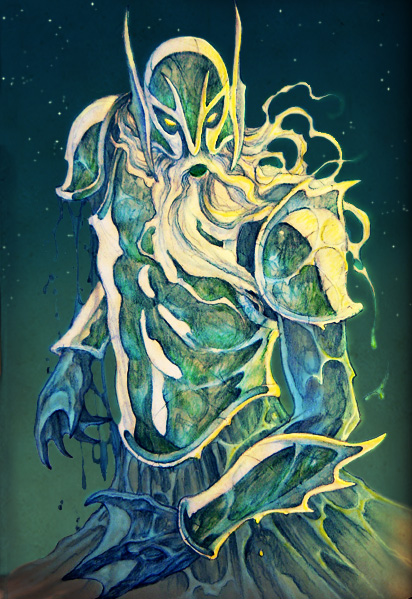
[Ulmo] does not love to walk upon the land, and will seldom clothe himself in a body after the manner of his peers. If the Children of Eru beheld him they were filled with a great dread; for the arising of the King of the Sea was terrible, as a mounting wave that strides to the land, with dark helm foam-crested and raiment of mail shimmering from silver down into shadows of green. ... Ulmo's voice is deep as the deeps of the ocean, which only he has seen.

Silmarillion, "Valaquenta"

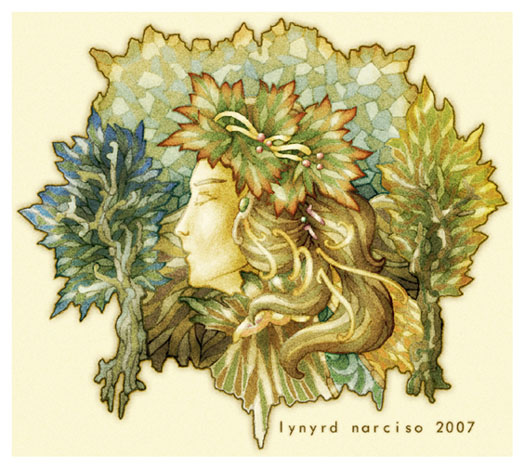
In the form of a woman, [Yavanna] is tall, and robed in green; but at times she takes other shapes. Some there are who have seen her standing like a tree under heaven, crowned with the sun; and from all its branches there spilled a golden dew upon the barren earth ...

Silmarillion, "Valaquenta"

In Angband Morgoth forged for himself a great crown of Iron, and he called himself King of the World. In token of this he set the Silmarils in this crown. His hands were burned black by the touch of those hallowed jewels, and black they remained ever after; nor was he ever free from the pain of the burning, and the anger of the pain.
...
Nonetheless his majesty as one of the Valar long remained, though turned to terror.

Silmarillion, "Of the Flight of the Noldor"

[Arien, Maia of the Sun] was chosen because she had not feared the heats of Laurelin,, and was unhurt by them, being from the beginning a spirit of fire, whom Melkor had not deceived nor drawn into his services. To bright were they eyes of Arien for even the Eldar to look on, and leaving Valinor she forsook the form and raiment which like the Valar she had worn there, and she was as a naked flame, terrible in the fullness of her splendour.

Silmarillion, "Of the Sun and Moon"


Of old there was Sauron the Maia..... He became the most trusted of the servents of the Enemy, and the most perilous, for he could asssume many forms, and for long if he willed he could still appear noble and beautiful, so as to deceive all but the most wary.

Silmarillion, "Of the Rings of Power and the Third Age"

[During the fall of Númenor] the world was broken, and the land was swallowed up, and the seas rose over it, and Sauron himself went down into the abyss. But his spirit arose and fled back on a dark wind to Middle-Earth, seeking a home.

[After the fall of Númenor, Sauron returned to his old haunts in Mordor, in Middle Earth.] There now he brooded in the dark, until he had wrought for himself a new shape; and it was terrible, for his fair semblance had departed for ever when he was cast into the abyss at the drowning of Númenor.

Silmarillion, "Of the Rings of Power and the Third Age"

But at last the siege was so strait that Sauron himself came forth; and he wrestled with Gil-galad and Elendil, and they both were slain, and the sword of Elendil broke under him as he fell. But Sauron also was thrown down, and with the hilt-shard of Narsil Isildur cut the Ruling Ring from the hand of Sauron and took it for his own. Then Sauron was for that time vanquished, and he forsook his body, and his spirit fled far away and hid in waste places; and he took no visible shape again for many long years.

Silmarillion, "Of the Rings of Power and the Third Age"

[Gandalf describes his battle with the Balrog:]
" ... I threw down my enemy, and he fell from the high place and broke the mountain-side where he smote it in his ruin. Then darkness took me, and I strayed out of thought and time, and I wandered far on roads that I will not tell.
"Naked I was sent back -- for a brief time, until my task is done. And naked I lay upon the mountain-top. ... There I lay staring upward, while the stars wheeled over, and each day was as long as a life-age of the earth. ... And so at the last Gwaihir the Windlord [Chief of the Eagles] found me again, and he took me up and bore me away."

The Two Towers, "The White Rider"
(According to the timeline in Appendix B, Gandalf was dead for 19 days.)

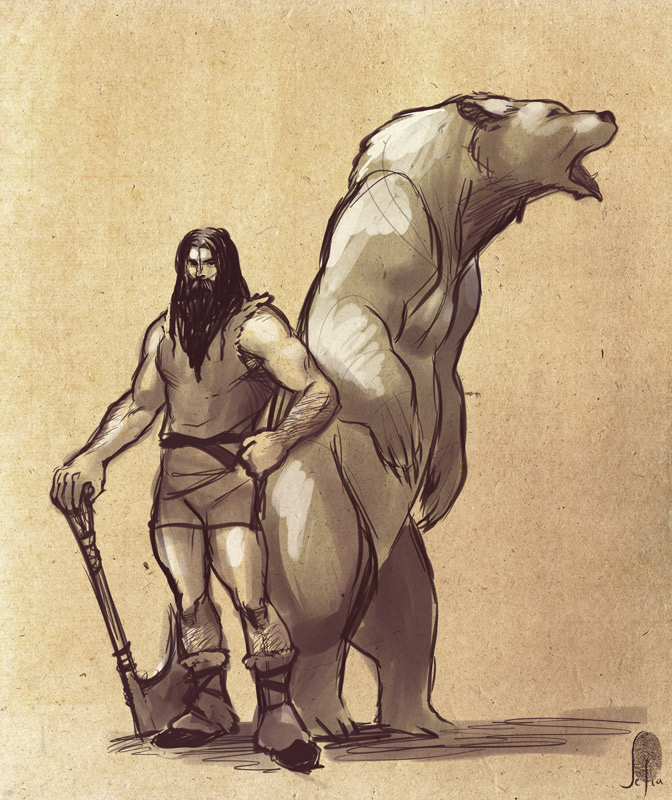
"If you must know more, his name is Beorn.
He is very strong, and he is a skin-changer.
"... He changes his skin: sometimes he is a huge black bear, sometimes he is a great strong black-haired man with huge arms and a great beard. I cannot tell you much more, though that ought to be enough. Some say that he is a bear descended from the great and ancient bears of the mountains that lived there before the giants came. Others say that he is a man descended from the first men ... I cannot say. ... He is not the sort of person to ask questions of. At any rate he is under no enchantment but his own. ... As a man he keeps cattle and horses that are nearly as marvelous as himself. ...
As a bear he ranges far and wide."

The Hobbit, Chapter 7

"The realm of Sauron is ended!" said Gandalf.
"And as the Captains gazed south to the Land of Mordor, it seemed to them that, black against the pall of cloud, there rose a huge shape of shadow, impenetrable, lightning-crowned, filling all the sky. Enormous it reared above the world, and stretched out toward them a vast threatening hand, terrible but impotent: for even as it leaned over them, a great wind took it, and it was all blown away, and passed; and a hush fell.

Return of the King, "The Field of Cormallen"

"To the dismay of those that stood by, about the body of Saruman a grey mist gathered, and rising slowly to a great height like smoke from a fire as a pale shrouded figure it loomed over the Hill. For a moment it wavered, looking to the West; but out of the West came a cold wind, and it bent away, and with a sigh dissolved into nothing.

Return of the King, "The Scouring of the Shire"