
JRR Tolkien gives weapons and armor special attention in his books. To clarify, this article ranges a bit larger than simple weaponry, since warfare includes not only the tools and weapons, but defenses, tactics, and natural ability.

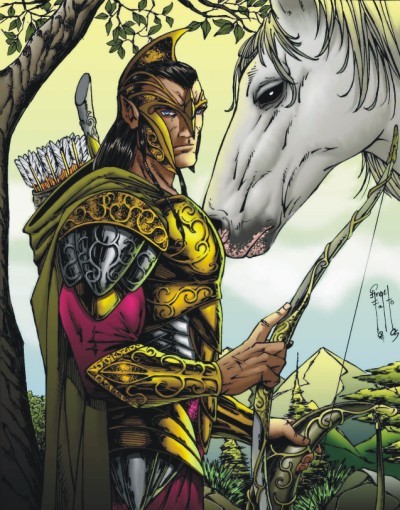 |
| Orome, the Hunter |
As Melko began corrupting and despoiling the world by creating many unnatural monsters, weapons became necessary, if not preferred, by Oromë, the great hunter. He's recorded as often in Middle-Earth hunting these unnatural abominations with bow, arrow, spear and javelins.Those first weapons are the same as those of Human antiquity. Archaeologists of the Prehistoric eras claim that humans used wooden clubs, sling and stone, shaped spear, knife, bow and arrow. The elves would have copied and constructed those first weapons on the Great Trek and learned to use them from Oromë himself and each other.
Aulë, the Vala Inventor in Aman would have crafted tools and weapons that human history records ancient: the hammer, the shield, the staff, the sickle, the chain, the shackle, and the bola. They are only incidentally weapons, firstly being used as agricultural, husbandry, and crafting tools.
Quenya words for weapons of antiquity:
- Dagger, Knife: sicil (Noldorin Sindarin: sigil
- Axe: pelekko, (North Sindarin: hathol, Khuzdul: baruk or burk )
- Bow quinga, ( Noldorin Sindarin: peng also poetically cû ("arch"))
- Helmet: cassa, harna, harpa and carma
- Shield: turma, umbas (umbaÞ); (Þ is the letter "thorn" with a "th" sound)
- Spear: hatal and ehte
This would be partial list of names, since elves name everything several ways, including weapons. Naming and even inscribing names on them is wholly in elvish character. Many elvish and ainu tools and weapons had individual names, especially if the object is meaningful and unique. (Wikipedia List of Middle-earth weapons and armour)
ANCIENT WEAPONRY:
This brings elvish warfare into the Ancient era of Earth warfare: bronze then iron sword, shield, helmet, armor, crossbow,
The Silmarillion chapter 7
when Melkor saw that these lies were smouldering, and that pride and anger were awake among the Noldor, he spoke to them concerning weapons; and in that time the Noldor began the smithying of swords and axes and spears. Shields also they made displaying the tokens of many houses and kindreds that vied one with another; and these only they wore abroad, and of other weapons they did not speak, for each believed that he alone had received the warning. And Fëanor made a secret forge, of which not even Melkor was aware; and there he tempered fell swords for himself and for his sons, and made tall helms with plumes of red. Bitterly did Mahtan rue the day when he taught to the husband of Nerdanel all the lore of metalwork that he had learned of Aulë.
The passage implies Mahtan taught Feanor to make swords before Melko put the idea in their heads. Thus the swords Noldor elves might bear before Melko is out of prison are the very earliest ones ever made, so sword-craft and technique are new in the Age of the Trees, making instruction classes on sword use and defense especially appropriate. Noldor invented it.
it clear that Feanor's "fell swords" are a new invention, but it's highly likely more normal swords already existed. Fell: (in this sense) destructive, deadly, from Middle English "felon"[wicked], related to "villain", "filet", and "warlock"
a few other notes about swords: images: http://www.squidoo.com/lord-of-the-rings-swords
- Sword: makil, macil, (Noldorin Sindarin: crist, magl, magol, North Sindarin magor)
- Variations: lango (broad sword), lhang (curved, long two-handed sword for movie Elves)
- Armor has no Quenya word, but elves had it.
 |
| The Kinslaying at Algualondë |
Ted Nasmith's fantastic art clearly shows armor, including the red-plumed helms and others in the not-too-distant future, showing Noldor in melee with shields, swords and armor before humanity had awoken.
Looking even farther forward in time....
When Melkor returned to Middle-earth after stealing the Silmarils, his armies attacked the Sindar elves. Those elves were almost totally unprepared, lacking in heavy weapons and suffering heavy casualties but not succumbing. This event was the beginning of thousands of years on and off warfare against the forces of darkness. The elves or dwarves of Middle-Earth may have been developed some Ancient and Antiquity weaponry independently later, but JRRT makes the high Noldor elves the solution to this imbalance. Here are two quick quotes:
from -Unfinished Tales, The Disaster of the Gladden Fields. [Of the Dúndain:]
“They had with the teaching of the Noldor acquired great skill in the forging of swords, of axe-blades, and of spearheads and knives.”
from -The Silmarillion, Akallabêth [Of the Numenorian]
"Eönwë came among them and taught them great lore."
Eonwë is one of the strongest of the Ainu, and a sword master himself, but nowhere is he the inventor of the thing; although he is a herald and messenger, apparently Eonwë learned sword work from the Noldor, mastered it, and passed it on.
Even Men get armor with Noldor guidance, once both meet in Middle Earth. Noldor elves continue their innovations in warfare, including other "Ancient" techniques: fortifications, rams and ladders, the war horse and , chariots and war-ships. In later ages, full "medieval" warfare is paralelled in Lord of the Rings: siege towers, ramps, cavalry with lances, infantry formations, plate armor, and the introduction of explosives.
 |
| Fingon and Gothmog, Ted Nasmith |
we have several hundred years of elvish experience
with the bow, the arrow, the knife, the stone.
with the bow, the arrow, the knife, the stone.
the javelin and the spear are well known,
as are healing with herbs and rest.
as are healing with herbs and rest.
Noldor are just leaning the use of swords, armor, and shields.
And the first elvish defensive technique: safety in numbers.
Their shared wisdom and skill is undefeated.
This was a presentation and discussion of his fictional history of armaments, warfare and tactics as regards JRR Tolkien's works.
Tirion Forest is a Noldor Elf roleplaying sim, set in the age of the Trees, the noon-time of Aman, when evil is securely bound and the elves and the world are in harmony. Mostly.
