
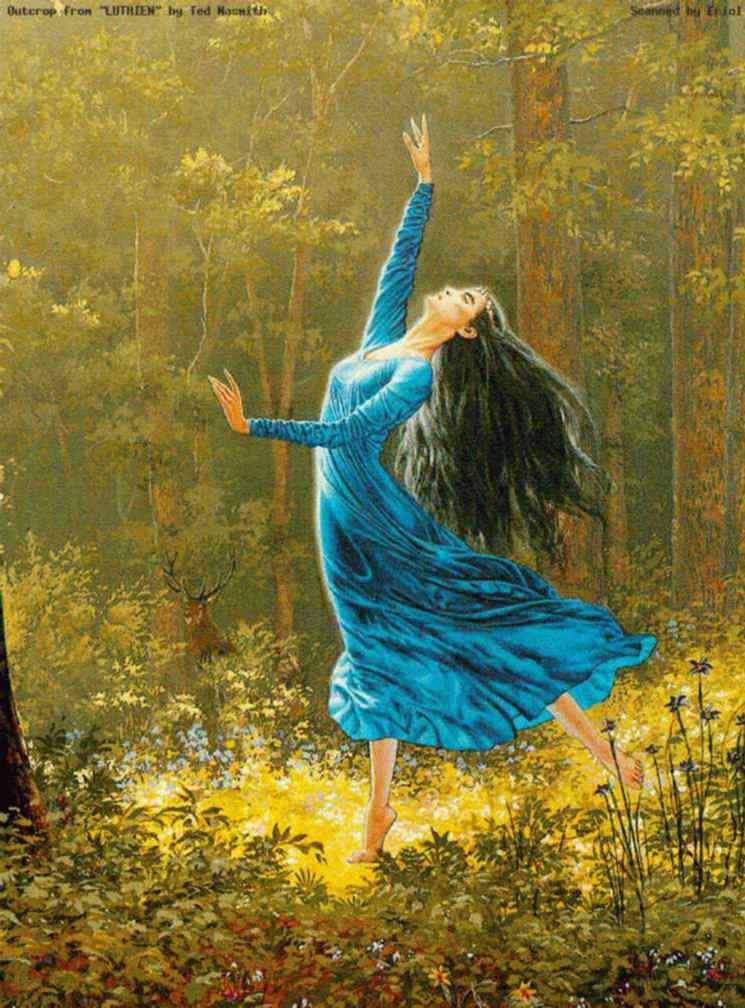
The lovely poem spoke to me especially since I have the huge honor of role-playing Aule in Second-Life "Tirion Forest" and nearby areas for the last several years. The image is very similar to a scene I and my Yavanna played many months ago, but written infinitely more eloquently.
With the Larner's permission, I mirror
He found her singing in the darkness beneath Varda's stars, and he smiled. Of green things she sang, of trees and grass and scented flowers.
He entered the clearing, adding his song to hers, singing of rich soil and shining minerals, soft sand and smooth stones.
He could tell she was glad he had joined her, for now she began to sway as she sang of blossoms and fruit.
He stepped to the side, singing of clay and mineral-laden water, heated by the earth and given to the relief of aching joints and exhaustion.
She sang of the sweetness of apples.
He sang of the richness of cups made from the metals to be taken from the earth, and how they would be ready to hold the apple's juices. Their hands met as their steps began to complement one another's.
She sang of the song of crickets hidden under leaves, of the song of frogs beside the banks of streams.
He sang of the song of the water as it poured over rocks and between boulders. They circled one another in their dance.
She sang of filled bellies and contented children.
He sang of useful items made such as knives to peel fruit and prepare vegetables to be eaten.
He lifted her easily high into the air, and she laughed as she sang of the comfort of growing things.
He responded with the reassurance of the reliability of the earth and its bones. He set her upon her feet.
She paused, then held out her hands to him, her song slowed and seductive as she sang to him of the thanksgiving offered by trees and plants for the earth from which they grew.
He took her hands and drew her to him, singing of the consummation the earth could know only when growing things sprang from it and drew from its bounty.
He inclined his head, and she raised her face to meet his, and as Yavanna kissed her beloved Aulë their joined songs continued, more full and harmonious for their shared love and delight in one another.
And all of the world prepared for the Children of Iluvatar delighted in their shared dance.
Saturday, January 14, 2012

Tuesday, December 6, 2011
Name the Bad Guy Entries.
A handful of entrants gave multiple entries to "Name the Bad Guy"
Our Elven RP leader, Maralee Greenwood, teaches that The Silmarillion states that the Noldor do not speak Melkor's name and that JRRT wrote "The Fallen One" for them to use instead. Quoting Valaquenta, "Of The Enemies":
The phrase "Fallen One" never appears in Tolkien's the Silmarillion. The word "fallen" appears less than 20 times, and never in reference to Melkor. Still, the elves might indeed use "Fallen One" as the Quenya lantë (a moral fall) suggests "Lantwë". Of the Ainu, though, only Aulë claims "I have fallen into folly" in his chapter. Hearing the useful "Fallen" or "Lantwë" would make Aulë, fallen yet forgiven, regretful.
"NOT" ú-, in-, un-, prefix usually has a "bad" connotation
MUSICAL SOUND lin, lind-, linda
PEACE sérë, rainë, sívë;
suggesting "Úlinwë", "Úlin", "Úlinda", "Úsérë", "Úrainë", and "Úsívë".
The etymological roots of discord offer another direction:
BREAK APART terhat-; hat- ; ascat-
suggests: "Hatórë", "Hatenda"
JRRT's own names that the Noontide elves called The Bad Guy could fit our needs nicely "The Hunter" ("Roimë" in Quenya), "The Dark Rider", ("Moroquen") and "Dark Hunter" ("Moroimë"), even if all are similar to "Oromë".
Top prizes go to "Lantwë" (Fallen One), "Morier" (Dark One), and "Roklem" (arising in might backwards) for whimsey, style and brevity. Honorable mention goes to "The Discordant", translated as "Úlin", "Úrainë" or "Hatórë".
I'd like to make one entry myself, obvious yet overlooked:
"The Bad Guy": "Olcawë", or better, "Úwë".
The Noldor of Tirion in Second Life will soon get ALL these entries and the JRRT to use as they wish. I will take a survey among them after March 14 regarding which of these names actually get used and award another prize at that time.
Our Elven RP leader, Maralee Greenwood, teaches that The Silmarillion states that the Noldor do not speak Melkor's name and that JRRT wrote "The Fallen One" for them to use instead. Quoting Valaquenta, "Of The Enemies":
"Last of all is set the name of Melkor, He who arises in Might. But that name he as forfeited; and the Noldor, who among the Elves suffered most from his malice, will not utter it, and they name him Morgoth, the Dark Enemy of the World."This could justify the Noldor calling the bad guy Morgoth from the very beginning. Since the Noldor had not suffered anything unusual of his malice by the Noontide of Valinor, we play that the elves call The Bad Guy neither "Melkor" for fear of the power of the name, nor "Morgoth" for it hasn't been coined yet.
The phrase "Fallen One" never appears in Tolkien's the Silmarillion. The word "fallen" appears less than 20 times, and never in reference to Melkor. Still, the elves might indeed use "Fallen One" as the Quenya lantë (a moral fall) suggests "Lantwë". Of the Ainu, though, only Aulë claims "I have fallen into folly" in his chapter. Hearing the useful "Fallen" or "Lantwë" would make Aulë, fallen yet forgiven, regretful.
The Entries:
- ~ "Lantwë", Quenya for "The Fallen One"
- ~ "Límilawë" for "The Chained One"
- ~ "i túra nancar" for "The great destroyer"
- ~ "Morier" for Dark One,
- ~ "Feuyaer" for the disgusting one
- ~ "Ksher" for the Evil one
- ~ "Oklem" or "Roklem" are Melko and Melkor backwards, so as to mimick his feature that he never did anything on this own but only corrupted and distorted what others had made before, so we do not give him a "new" name but rather take the "old" one and corrupt it ourselves.
- ~ "First of tyrants", Quenya has no word for tyrant. Perhaps "First Night Lord", or "First Slave Lord" will do: Lómëheru-minya or Mólheru-minya
- ~ "Sourvoice", as stink- holwë + voice óma = "Holoma"
- ~ "Badsong" as bad Olca + song linde = "Olcalin"
- ~ "Shouty" or "Shouter" as "Ramando"
- ~ "The Discordant" deserves some thought:
Dis-cord"Discord" isn't in Quenya wordlists, nor most above, but these are:
~Lack of agreement among persons, groups, or things.
~Tension or strife resulting from a lack of agreement;
~strife, dispute, war, dissension.
~confused, harsh or inharmonious sound or sounds.
~a dissonance in music.
~To fail to agree or harmonize;
~clash.
"NOT" ú-, in-, un-, prefix usually has a "bad" connotation
MUSICAL SOUND lin, lind-, linda
PEACE sérë, rainë, sívë;
suggesting "Úlinwë", "Úlin", "Úlinda", "Úsérë", "Úrainë", and "Úsívë".
The etymological roots of discord offer another direction:
[Middle English, from Old French descorde, from Latin discordia, from discors, discord-, disagreeing : dis-, apart; see dis- + cor, cord-, heart; see kerd- in Indo-European roots.]HEART hón (physical heart), órë (inner mind), indo (mind, mood), enda (centre, soul or mind), elwen (is early “Qenya”).
BREAK APART terhat-; hat- ; ascat-
suggests: "Hatórë", "Hatenda"
Judging
JRRT's own names that the Noontide elves called The Bad Guy could fit our needs nicely "The Hunter" ("Roimë" in Quenya), "The Dark Rider", ("Moroquen") and "Dark Hunter" ("Moroimë"), even if all are similar to "Oromë".
Top prizes go to "Lantwë" (Fallen One), "Morier" (Dark One), and "Roklem" (arising in might backwards) for whimsey, style and brevity. Honorable mention goes to "The Discordant", translated as "Úlin", "Úrainë" or "Hatórë".
I'd like to make one entry myself, obvious yet overlooked:
"The Bad Guy": "Olcawë", or better, "Úwë".
The Noldor of Tirion in Second Life will soon get ALL these entries and the JRRT to use as they wish. I will take a survey among them after March 14 regarding which of these names actually get used and award another prize at that time.
Thursday, December 1, 2011
JRRT Names the Bad Guy
In preparing to award contest entry prizes, first a review of JRRT's words about him are in order. The interesting Tolkien Gateway site about Melko lists many names. Only some of them might have been used in the "Noontide of Valinor".
"Melkórë", "Melko", "Melegor", and "Meleko" are apparently Valarin, (spoken by the ainu) Eldarin, (spoken by the first elves) or Quenya (spoken by our Noldor Elves of Aman) names that Tolkien used in drafts, before he settled on the Quenya "Melkor" translated in the Silmarillion as “He who arises in might". These are likely related to the little used Eldarin (possibly Valarin) name "mbelekôro".
The early elves of Cuiviénen called him "The Hunter" ("Roimë" in Quenya) and "The Dark Rider", ("Moroquen"). There is a non-Silmarillion reference to "Dark Hunter" ("Moroimë") but not in this defining passage:
Feanor once calls the mightiest of all the dwellers in Eä "jail-crow of Mandos", but his name-calling doesn't stick until the darkening of Valinor and his father's murder:
Also in Sindarin, the elven language of Middle-Earth, are "Belegûr" for "He who arises in might" and "Belegurth" for "Great Death". "Belcha" is not used in Silmarillion, but others have ascribed it to a Sindarin dictionary. It's clearly not Eldarin nor Quenya nor Valarin, since none of those use an initial letter B.
Humans in later ages added "Dark Lord", "Dark King", "Dark King of Angband", "Black King" and "Lord of the Dark" to our antagonist's monikers.
The Bad Guy even gives himself a few titles. When speaking to Noldor, he calls himself "Vala" also, and "friend to the Noldor". When speaking to to Húrin, he claims "Master of the fates of Arda" (rightly belonging to Námo Mandos) and "Elder King", which was accurate in the brief time the Bad Guy was the only sentient creature in the World, until the arrival of meritous Manwë.
Fittingly, the Bad Guy gets exiled the last paragraph of the Silmarillion (emphases mine):
"Melkórë", "Melko", "Melegor", and "Meleko" are apparently Valarin, (spoken by the ainu) Eldarin, (spoken by the first elves) or Quenya (spoken by our Noldor Elves of Aman) names that Tolkien used in drafts, before he settled on the Quenya "Melkor" translated in the Silmarillion as “He who arises in might". These are likely related to the little used Eldarin (possibly Valarin) name "mbelekôro".
The early elves of Cuiviénen called him "The Hunter" ("Roimë" in Quenya) and "The Dark Rider", ("Moroquen"). There is a non-Silmarillion reference to "Dark Hunter" ("Moroimë") but not in this defining passage:
"if any of the Elves strayed far abroad, alone or few together, they would often vanish, and never return; and the Quendi [elves] said that the Hunter had caught them, and they were afraid. And indeed the most ancient songs of the Elves, of which echoes are remembered still in the West, tell of the shadow-shapes that walked in the hills above Cuiviénen, or would pass suddenly over the stars; and of the dark Rider upon his wild horse that pursued those that wandered to take them and devour them.""The Enemy" and "Great Enemy" are used thru time for the Bad Guy, but also for his chief in Middle-Earth, Sauron. Word lists render these as "Cotumo" and "Altacotumo"
Feanor once calls the mightiest of all the dwellers in Eä "jail-crow of Mandos", but his name-calling doesn't stick until the darkening of Valinor and his father's murder:
"Fëanor rose, and lifting up his hand before Manwë he cursed Melkor, naming him Morgoth, the Black Foe of the World; and by that name only was he known to the Eldar ever after."JRRT considered but set aside "Moriñgotho", "Moringotto" and "Moricotto" for "The Dark Enemy" here. The Sindarin "Bauglir", meaning "The Constrainer" appears the Silmarillion often but only as "Morgoth Bauglir".
Also in Sindarin, the elven language of Middle-Earth, are "Belegûr" for "He who arises in might" and "Belegurth" for "Great Death". "Belcha" is not used in Silmarillion, but others have ascribed it to a Sindarin dictionary. It's clearly not Eldarin nor Quenya nor Valarin, since none of those use an initial letter B.
Humans in later ages added "Dark Lord", "Dark King", "Dark King of Angband", "Black King" and "Lord of the Dark" to our antagonist's monikers.
The Bad Guy even gives himself a few titles. When speaking to Noldor, he calls himself "Vala" also, and "friend to the Noldor". When speaking to to Húrin, he claims "Master of the fates of Arda" (rightly belonging to Námo Mandos) and "Elder King", which was accurate in the brief time the Bad Guy was the only sentient creature in the World, until the arrival of meritous Manwë.
Fittingly, the Bad Guy gets exiled the last paragraph of the Silmarillion (emphases mine):
the Valar thrust [Morgoth himself ] through the Door of Night beyond the Walls of the World, into the Timeless Void; and a guard is set for ever on those walls, and Eärendil keeps watch upon the ramparts of the sky. Yet the lies that Melkor, the mighty and accursed, Morgoth Bauglir, the Power of Terror and of Hate, sowed in the hearts of Elves and Men are a seed that does not die and cannot be destroyed; and ever and anon it sprouts anew, and will bear dark fruit even unto the latest days.
Here ends the SILMARILLION.
Name the Bad Guy Contest
Arth Karas here, not quite fully in character as Aulë
Melko has many names in later Ages, but few in the Age of the Trees. As you can see in the chat below, the ones we have are a bit unwieldy or being avoided. Thus, we need a unique and appropriate name to call him.
Acceptable names will be:
~ Either chosen or translated directly from JRRT Tolkien sources
~ rooted in Quenya or Valarin or English, since Sindarin, Latin and other such languages are unknown yet in our RP.
~ clearly not some other character nor confusingly similar to such
~ accurate to Melko's character
~ not overly respectful (for reasons of story arcs to come)
Please look over what I have here and send me names by SL IM, which forwards to arth.karas@-at-gmail.-dot-com. Multiple submissions accepted. I will choose the acceptable submissions (and likely write an article here about which and why) based on creativity, originality, duplication and whimsy. After entries are collected thru Jan 1, 2012, I will split a L$ 1200 entry prize among to Sheriwood and ~Aglarond~ group members. All accepted suggestions will go to Noldor Elves of Tirion to use in role play. From their natural selection by use, I will choose a grand prize winner of another L$ 600 by March 4, 2012.
http://tolkiengateway.net/wiki/Morgoth
http://en.wikipedia.org/wiki/Melkor
http://aulethesmith.blogspot.com/2010/09/aule-versus-melkor.html
http://users.bestweb.net/~jfgm/valaquenta/texts/21%20Melkor.htm
Open Chat excerpt prompting this contest:
Second Life, Tirion Forest Sim 01Dec2011 ~ 1400 PST
During a 3 player discussion on Melko's character.
Marwen: The One's mind has turned so bad
Aulë: WHAT?
Marwen: this cannot be a mere coincidence
Aulë is agitated. WHAT ARE YOU SAYING?
Anairë: The evil one do you mean?
Marwen: My lord
Aulë mimics Marwen: The One's mind has turned so bad
Marwen: forgive me Mylord
Marwen: my wording is poor indeed
Aulë: THE ONE is Eru, Ilúvatar.
Aulë: WHAT DID YOU THINK YOU MEANT?
Marwen: The Fallen One
Aulë: pfff.
Aulë: Just call him Melko.
Aulë: Melkor.
Aulë: he's not "fallen" any more than I am.
Marwen: we are not supposed to say his name
Marwen: that's why
Anairë: Lady Yavanna suggested we not name him?
Aulë stammers a moment.
Marwen looks down ashamed
Anairë: You may be safe from his attention Vala Aule...but if we came to his special notice
Aulë: composes himself.
Aulë: Your respect of the Lady Yavanna's suggestions are wholly commendable. I'm proud of you.
Aulë: and I see her point... and yours.
Anairë: We are a little more vulnerable than you are Vala Aule...smiles
Aulë: I'm already Melko's target for mischief.
Aulë: aye... and your keeping a low profile makes sense.
Anairë: Oh he has caused you harm?
Aulë waves aside the question impatiently...
Aulë: but when the names you chose to use infect your very speech and ideation to say such silly things as I just heard...
Aulë: you need to choose another solution.
Anairë: nods
Marwen: we learned at the last barding his name among the Noldor is "The Fallen One"
Aulë: might I suggest something less similar to Eru's name?
Anairë: mmm thinks of a name
Aulë: in my own though, he is often "HotHead"
Aulë: and lately... "Chained"
Anairë: He who is chained would not be mistaken
Anairë: Well unless any Noldor are taken and chained.... shudders
Marwen: and you made the chains
Aulë: aye. I made them special just for him. Fire is my domain as well among the Vala now.
Marwen: so it would be your domain to make an exception here too
Aulë: I have no objections to naming Melko after chains or fire. They are his more than mine.
Aulë: Perhaps I should host a contest...
Marwen: this would leave us at "the chained one"
Anairë: What aspect was he who is chained supposed to have dominance over if the song was perfect?
Marwen: deliberately without capital letters
Aulë: Melko is an aspect of extremes: very hot, very cold, very beautiful, very abhorrent.
Aulë: and he has great gifts in all areas of creation.
Aulë: "what to name Melko, when you must speak of him"
Aulë: yes.... I think I will do that. Sponsor a creative contest to find names for that character...
Anairë: Evil seems a good description of him
Anairë: but there are many names for such an evil one
Aulë: names that are at once accurate, yet not overly respectful.
Aulë hums in thought, taking up quill and scroll.
Melko has many names in later Ages, but few in the Age of the Trees. As you can see in the chat below, the ones we have are a bit unwieldy or being avoided. Thus, we need a unique and appropriate name to call him.
NAME THE BAD GUY CONTEST
Acceptable names will be:
~ Either chosen or translated directly from JRRT Tolkien sources
~ rooted in Quenya or Valarin or English, since Sindarin, Latin and other such languages are unknown yet in our RP.
~ clearly not some other character nor confusingly similar to such
~ accurate to Melko's character
~ not overly respectful (for reasons of story arcs to come)
Please look over what I have here and send me names by SL IM, which forwards to arth.karas@-at-gmail.-dot-com. Multiple submissions accepted. I will choose the acceptable submissions (and likely write an article here about which and why) based on creativity, originality, duplication and whimsy. After entries are collected thru Jan 1, 2012, I will split a L$ 1200 entry prize among to Sheriwood and ~Aglarond~ group members. All accepted suggestions will go to Noldor Elves of Tirion to use in role play. From their natural selection by use, I will choose a grand prize winner of another L$ 600 by March 4, 2012.
Learn more:
http://tolkiengateway.net/wiki/Morgoth
http://en.wikipedia.org/wiki/Melkor
http://aulethesmith.blogspot.com/2010/09/aule-versus-melkor.html
http://users.bestweb.net/~jfgm/valaquenta/texts/21%20Melkor.htm
Open Chat excerpt prompting this contest:
Second Life, Tirion Forest Sim 01Dec2011 ~ 1400 PST
During a 3 player discussion on Melko's character.
Marwen: The One's mind has turned so bad
Aulë: WHAT?
Marwen: this cannot be a mere coincidence
Aulë is agitated. WHAT ARE YOU SAYING?
Anairë: The evil one do you mean?
Marwen: My lord
Aulë mimics Marwen: The One's mind has turned so bad
Marwen: forgive me Mylord
Marwen: my wording is poor indeed
Aulë: THE ONE is Eru, Ilúvatar.
Aulë: WHAT DID YOU THINK YOU MEANT?
Marwen: The Fallen One
Aulë: pfff.
Aulë: Just call him Melko.
Aulë: Melkor.
Aulë: he's not "fallen" any more than I am.
Marwen: we are not supposed to say his name
Marwen: that's why
Anairë: Lady Yavanna suggested we not name him?
Aulë stammers a moment.
Marwen looks down ashamed
Anairë: You may be safe from his attention Vala Aule...but if we came to his special notice
Aulë: composes himself.
Aulë: Your respect of the Lady Yavanna's suggestions are wholly commendable. I'm proud of you.
Aulë: and I see her point... and yours.
Anairë: We are a little more vulnerable than you are Vala Aule...smiles
Aulë: I'm already Melko's target for mischief.
Aulë: aye... and your keeping a low profile makes sense.
Anairë: Oh he has caused you harm?
Aulë waves aside the question impatiently...
Aulë: but when the names you chose to use infect your very speech and ideation to say such silly things as I just heard...
Aulë: you need to choose another solution.
Anairë: nods
Marwen: we learned at the last barding his name among the Noldor is "The Fallen One"
Aulë: might I suggest something less similar to Eru's name?
Anairë: mmm thinks of a name
Aulë: in my own though, he is often "HotHead"
Aulë: and lately... "Chained"
Anairë: He who is chained would not be mistaken
Anairë: Well unless any Noldor are taken and chained.... shudders
Marwen: and you made the chains
Aulë: aye. I made them special just for him. Fire is my domain as well among the Vala now.
Marwen: so it would be your domain to make an exception here too
Aulë: I have no objections to naming Melko after chains or fire. They are his more than mine.
Aulë: Perhaps I should host a contest...
Marwen: this would leave us at "the chained one"
Anairë: What aspect was he who is chained supposed to have dominance over if the song was perfect?
Marwen: deliberately without capital letters
Aulë: Melko is an aspect of extremes: very hot, very cold, very beautiful, very abhorrent.
Aulë: and he has great gifts in all areas of creation.
Aulë: "what to name Melko, when you must speak of him"
Aulë: yes.... I think I will do that. Sponsor a creative contest to find names for that character...
Anairë: Evil seems a good description of him
Anairë: but there are many names for such an evil one
Aulë: names that are at once accurate, yet not overly respectful.
Aulë hums in thought, taking up quill and scroll.
Saturday, October 29, 2011
Relative Quenya Names
This in Aulë's Second Life In-box:
Allasár, Mellonin! (Blessings, girlfriend!)
My favorite source for researching such questions is the website Ardalambion
In the downloaded Quenya files, I use "find" to locate my words of interest:
~~aunt.... not found ...
~~niece... not found ....
Failing there, I look up related words and educe the words we want: aunt = parent's sister. niece = siblings's daughter
~~PARENT #nostar (pl nostari) or ontan (pl ontani) ; also father ontaro; mother: ontarë or ontari .
~~'s is possesive: -rya (possessive suffix, e.g. aratarya "her sublimity". for all genders . words ending in a consonant take the shorter form -ya, e.g. talya “his foot”,
~~SISTER nésa (þ; older form néþa), colloquially also nettë (probably netti-); also "sister" seler (Þ) (pl. selli), onómë, onónë; SISTER (usually not of bloodkinship) osellë (Þ)
so,
~~AUNT: parent's sister: nostar+rya+nésa, shortens to nénostárya. less formal: nettë-ontar-rya, shortens to nettontarya. even shorter, "nettarya".
That is still a bit of a un-resonant mouthful. Maybe something prettier will show up with more searching.
~~sibling... not found. But I have sister, so.
~~BROTHER háno, colloquial hanno . also toron (pl. torni) (= natural brother); cf. otorno "sworn brother, associate".
~~DAUGHTER selyë; also yendë, yen, yeldë, suffixes: –iel (e.g. Uinéniel "daughter of Uinen") obsolete: -wen, -yel.
so
~~NIECE is either sister's daughter: nésiel, nettiel , seleriel or onómiel .... or brother's daughter: hanniel, hánoyel, toroniel
Noldor elves in our early RP age would use archaic forms.: néþyel ( Néthyel) or toroniel. I like those.
You can easily find the other words in the pages above, except for grandparent:
~~ Grand not found except grandchild. After poking around, I find.
~~DOUBLE (prob. adj) atwa, tanta; DOUBLE (vb) tatya- (repeat). (Note: tatya also means "second".) –AT(AT), TATA
This "tatya" is especially apt: the First of the Noldor clan to awaken was named Tata. Then consider AUNT in spanish or french is tanta or tante.
So
~~GRANDMOTHER: tatya-amillië -> tatamillië.
and
~~AUNT = grandmother's daughter: tantamilier. Even simpler:
~~AUNT = second mama: tatyamil.
That resonates.
Love, Arth.
hello
I think you are the language expert in Tirion and I was wondering if you could tell me the correct forms of address for family members as my friend and I are playing aunt and neice. Do you know what the Quenya elvish for these are?
Also mother, father, brother, sister, and if possible, grandparents?
We've been using English terms, but they jar a bit in Tirion. I think the Quenya would be more resonant :)
Thankyou!
Iminwiel
Allasár, Mellonin! (Blessings, girlfriend!)
My favorite source for researching such questions is the website Ardalambion
In the downloaded Quenya files, I use "find" to locate my words of interest:
~~aunt.... not found ...
~~niece... not found ....
Failing there, I look up related words and educe the words we want: aunt = parent's sister. niece = siblings's daughter
~~PARENT #nostar (pl nostari) or ontan (pl ontani) ; also father ontaro; mother: ontarë or ontari .
~~'s is possesive: -rya (possessive suffix, e.g. aratarya "her sublimity". for all genders . words ending in a consonant take the shorter form -ya, e.g. talya “his foot”,
~~SISTER nésa (þ; older form néþa), colloquially also nettë (probably netti-); also "sister" seler (Þ) (pl. selli), onómë, onónë; SISTER (usually not of bloodkinship) osellë (Þ)
so,
~~AUNT: parent's sister: nostar+rya+nésa, shortens to nénostárya. less formal: nettë-ontar-rya, shortens to nettontarya. even shorter, "nettarya".
That is still a bit of a un-resonant mouthful. Maybe something prettier will show up with more searching.
~~sibling... not found. But I have sister, so.
~~BROTHER háno, colloquial hanno . also toron (pl. torni) (= natural brother); cf. otorno "sworn brother, associate".
~~DAUGHTER selyë; also yendë, yen, yeldë, suffixes: –iel (e.g. Uinéniel "daughter of Uinen") obsolete: -wen, -yel.
so
~~NIECE is either sister's daughter: nésiel, nettiel , seleriel or onómiel .... or brother's daughter: hanniel, hánoyel, toroniel
Noldor elves in our early RP age would use archaic forms.: néþyel ( Néthyel) or toroniel. I like those.
You can easily find the other words in the pages above, except for grandparent:
~~ Grand not found except grandchild. After poking around, I find.
~~DOUBLE (prob. adj) atwa, tanta; DOUBLE (vb) tatya- (repeat). (Note: tatya also means "second".) –AT(AT), TATA
This "tatya" is especially apt: the First of the Noldor clan to awaken was named Tata. Then consider AUNT in spanish or french is tanta or tante.
So
~~GRANDMOTHER: tatya-amillië -> tatamillië.
and
~~AUNT = grandmother's daughter: tantamilier. Even simpler:
~~AUNT = second mama: tatyamil.
That resonates.
Love, Arth.
Saturday, September 3, 2011
the Naming of Elves
JRRT's elves, according to the notes Christopher Tolkien compiled into a collection called "the Ring of Morgoth", always have at least three names. There is some ceremony about the essë "naming" of High Elves.
1. the public essi ("father-name") is given at birth. Usually the son's name takes after the father and the daughter's name takes after the mother. The father announces it to the extended family and thus the world. The first Noldo king Finwë named his first-born son "Curufinwë" after himself [curu- "skill" + fin "nimble, clever" + -wë "man"]
2. the given-names, most prominent and earliest of these is the amilessë ("mother-name"), based on sight, insight or foresight. These might be public or private, but have more to do with character than family. Finwë's same eldest son was mother-named by Miriel as "Fëanáro" [ fëa "spirit" + nár "flame" + -o masculine]. This, later translated into the Middle-Earth elvish language Sindarin, become "Fëanor". In SL's Arda, that same character as gathered a few of these informal names, "Mundotarië" [nose-high for "Arrogant one"] among them.
3. the epessë ("after-name" or honorific) is a self-chosen name taken at a time of childhood and again infrequently when the elf deems it suitable, usually at times of life changing importance as assumption of a throne or staggering loss. Again these might be public or private, but the first chosen-name is taken and kept private (but not secret) to family when the child has mastered language. That same elf likely kept his own chosen names to himself, since I find no record of it. In SL's Arda, though, that character answers to 'mela' [beloved] from Nerdael (and no one else) and the name of the SL account, "Tlaloc"
Another example of naming is Gil-galad ("Star of Radiance"), which was the mother-name of the last High King of the Noldor. His father-name was Rodnor. Upon becoming king he was given the epessë Ereinion ("Scion of Kings") and called Ereinion Gil-gilad.
In role-play, then, Elves have at least three names: an everyday name from the father about the family, a personal name from the mother about the appearance, and one too private to be uttered out loud. The name players choose for the character can be be assigned to one of the three major sources: father, mother (and other seers) and self for family, appearance, or something ineffable [too private, large or sacred to be said aloud], thus attributed to a childhood source.
Substitute "elf" for "cat" below, and T.S Eliot echoes J.R.R. Tolkien:
1. the public essi ("father-name") is given at birth. Usually the son's name takes after the father and the daughter's name takes after the mother. The father announces it to the extended family and thus the world. The first Noldo king Finwë named his first-born son "Curufinwë" after himself [curu- "skill" + fin "nimble, clever" + -wë "man"]
2. the given-names, most prominent and earliest of these is the amilessë ("mother-name"), based on sight, insight or foresight. These might be public or private, but have more to do with character than family. Finwë's same eldest son was mother-named by Miriel as "Fëanáro" [ fëa "spirit" + nár "flame" + -o masculine]. This, later translated into the Middle-Earth elvish language Sindarin, become "Fëanor". In SL's Arda, that same character as gathered a few of these informal names, "Mundotarië" [nose-high for "Arrogant one"] among them.
3. the epessë ("after-name" or honorific) is a self-chosen name taken at a time of childhood and again infrequently when the elf deems it suitable, usually at times of life changing importance as assumption of a throne or staggering loss. Again these might be public or private, but the first chosen-name is taken and kept private (but not secret) to family when the child has mastered language. That same elf likely kept his own chosen names to himself, since I find no record of it. In SL's Arda, though, that character answers to 'mela' [beloved] from Nerdael (and no one else) and the name of the SL account, "Tlaloc"
Another example of naming is Gil-galad ("Star of Radiance"), which was the mother-name of the last High King of the Noldor. His father-name was Rodnor. Upon becoming king he was given the epessë Ereinion ("Scion of Kings") and called Ereinion Gil-gilad.
In role-play, then, Elves have at least three names: an everyday name from the father about the family, a personal name from the mother about the appearance, and one too private to be uttered out loud. The name players choose for the character can be be assigned to one of the three major sources: father, mother (and other seers) and self for family, appearance, or something ineffable [too private, large or sacred to be said aloud], thus attributed to a childhood source.
Substitute "elf" for "cat" below, and T.S Eliot echoes J.R.R. Tolkien:
The Naming of Cats is a difficult matter,
It isn't just one of your holiday games;
You may think at first I'm as mad as a hatter
When I tell you, a cat must have THREE DIFFERENT NAMES.
First of all, there's the name that the family use daily,
Such as Peter, Augustus, Alonzo or James,
Such as Victor or Jonathan, George or Bill Bailey -
All of them sensible everyday names.
There are fancier names if you think they sound sweeter,
Some for the gentlemen, some for the dames:
Such as Plato, Admetus, Electra, Demeter -
But all of them sensible everyday names.
But I tell you, a cat needs a name that's particular,
A name that's peculiar, and more dignified,
Else how can he keep his tail perpendicular,
Or spread out his whiskers, or cherish his pride?
Of names of this kind, I can give you a quorum,
Such as Munkustrap, Quaxo, or Coricopat,
Such as Bombalurina, or else Jellylorum -
Names that never belong to more than one cat.
But above and beyond there's still one name left over,
And that is the name that you never will guess;
The name that no human research can discover -
But THE CAT HIMSELF KNOWS, and will never confess.
When you notice a cat in profound meditation,
The reason, I tell you, is always the same:
His mind is engaged in a rapt contemplation
Of the thought, of the thought, of the thought of his name:
His ineffable effable
Effanineffable
Deep and inscrutable singular Name.
Childhood of the Children of Ilúvatar
JRR Tolkien's Silmarillion uses the word "child" hundreds of times, more than "honor", "pain", "life" or "death".
From the Christopher Tolkiens' collection of his fathers unpublished drafts called "Morgoth's Ring" comes "OF THE VALAR AT ITS MAKING", Aelfwine's (narrator's) Preamble: Despite the similarities or appearance, Men find elf-children strange: too verbal, too sage, too graceful. The chapter immediately goes on to mention small limbs and stature, skill in words and grace in motion. At the end of the third year, Men outstrip the Elves in stature, while elves "lingered in the first spring of childhood". By age 20, elves appear no more than 7. They attain full stature and shape between age 50 and age 100.
One oddity here is that few of us role-players are old enough to easily be anything but a very young elf, causing an odd gap between what experiential wisdom we are capable of as players and what we should be playing. However, there is a nice ameliorating factor to that in this particular "Age of the Two Trees" RP:
This nicely lays out the role of Ainur compared to Elves: guides, not masters; kindred, not elders. I've described it as "Regents for the children of the King, raising the children to take on ruler-ship at maturity." JRRT has this to say on that:
From the Christopher Tolkiens' collection of his fathers unpublished drafts called "Morgoth's Ring" comes these bits of Ainulindalë version C:
Wedded couples might choose one another early in youth, even as children, and the betrothal awaited the judgements of the parents.
"A year passes between the begetting and the birth of an elf-child, so that the days of both are the same or nearly so, and it is the day of begetting that is remembered year by year. For the most part, these days come in the Spring."
Childbearing is uncommon late in an elf's life. While elves do not apparently age, their energies do dwindle, and childbearing takes a great toll on the mother. This early marriage period is called 'days of the children' and is a merry part of life. To avoid the drama of single-parent-hood, the elves would bear children only in days of happiness and peace if they could.
There were seldom more than four elf-children in any one house, and only once more than six. "Their [elvish] families, or houses, were held together by love and deep feeling of kinship in mind and body; and the children needed little governing or teaching". Linguistically, elves said not "I have three children", but "three children have been added unto me", of "are with me", or "are in my house"
Physically, children naturally resemble their parents, but not necessarily spiritually. The child's fea is not derived from the parent's, but is newly made or newly re-born, according to JRRT.
After bearing Feanor, Miriel simply gave up living. "All my strength has gone into him," she claimed, then she gave up living to rest in Lorien. Morgoth's Ring has a full chapter of the Valar debating and arguing at great lengths over this act and what to do about it, since Finwë himself had moaned "Is there no healing in Valinor?"
 It was Nienna who spoke the most tellingly and eloquently, I think, even though she disagreed with Aulë thus:
That is, for better or worse, how the Childhood of the Children of Ilúvatar is to be.
"the Children of Ilúvatar are Elves and Men, the Firstborn and the Followers. And amid all the splendours of the World, its vast halls and spaces, and its wheeling fires, Ilúvatar chose a place for their habitation in the Deeps of Time and in the midst of the innumerable stars."J. R. R. Tolkien, Ainulindalë
From the Christopher Tolkiens' collection of his fathers unpublished drafts called "Morgoth's Ring" comes "OF THE VALAR AT ITS MAKING", Aelfwine's (narrator's) Preamble:
"The Eldar grew in bodilyform slower than Men, but in mind more swiftly. They learned to speak before they were one year old; and in the same time they learned to walk and to dance, for their wills came soon to the mastery of their bodies. Nonetheless, there was less difference between the two Kindred's, Elves and Men, in early youth; and a man who watched elf-children at play might well have believed that they were the children of Men, of some fair and happy people. For in their early days elf-children delighted still in the world about them, and the fire of their spirit had not consumed them and the burden of memory was still light upon them.
 Despite the similarities or appearance, Men find elf-children strange: too verbal, too sage, too graceful. The chapter immediately goes on to mention small limbs and stature, skill in words and grace in motion. At the end of the third year, Men outstrip the Elves in stature, while elves "lingered in the first spring of childhood". By age 20, elves appear no more than 7. They attain full stature and shape between age 50 and age 100.
One oddity here is that few of us role-players are old enough to easily be anything but a very young elf, causing an odd gap between what experiential wisdom we are capable of as players and what we should be playing. However, there is a nice ameliorating factor to that in this particular "Age of the Two Trees" RP:
"For Elves and Men are the Children; and since they [the Ainur] understood not fully that theme by which they entered in the Music none of the Ainur dared to add anything to their fashion. For which reason the Valar are to these kindreds rather their elders and their chieftains than their masters;
This nicely lays out the role of Ainur compared to Elves: guides, not masters; kindred, not elders. I've described it as "Regents for the children of the King, raising the children to take on ruler-ship at maturity." JRRT has this to say on that:
"if ever in their dealings wth Elves and Men, the Ainur have endeavored to force them when they would not be guided, this has seldom turned to good, howsoever good their intent.In a way JRRT is making a rule about education and child-rearing: "Force, when it happens, fails." It goes to back to RP when you are playing a "mature, full grown elf", in this age of the Trees, the race of elves is still in childhood and developing, giving all us RP'ers under the average ave of 75, (this only aged enough to play a young elf) the modifier of elven RACIAL immaturity, making our ages just about right to be elf children or grown elves in the child hood of the race.
From the Christopher Tolkiens' collection of his fathers unpublished drafts called "Morgoth's Ring" comes these bits of Ainulindalë version C:
"Then Ilúvatar spake, and he said: "Behold I love the world, and it is a mansion for Eldar (Elves) and Atani (Men). But the Elves shall be the fairest of earthly creatures, and they shall have and shall conceive more beauty than all my children, and they shall have greater bliss in this world."
"Dying [Eldar] are gathered in the halls of Mandos in Valinor, whence they often return and are reborn in their children."
And from the Ainulindalë version D:
"For Elves and Men are the Children; and since they understood not fully that theme by which they entered in the Music none of the Ainur dared to add anything to their fashion. For which reason the Valar are to these kindreds rather their elders and their chieftains than their masters; and if ever in their dealings with Elves and Men, the Ainur have endeavored to force them when they would not be guided, this has seldom turned to good, howsoever good their intent. The dealings of the Ainur have been mostly with the Elves, for Ilúvatar made the Eldar more like in nature to the Ainur, though less in might and stature, whereas to Men he gave strange gifts."
In JRRT's early drafts, we find a discarded word: "Valarindi" with fragments describing them as the children of the Valar, begotten of their love after their entry into Ea in Arda and numbered among the Maiar. They are the elder children of the World, and though their being began within Ea, yet they are of the race of the Ainur, who were before the world, and they have power and rank below that of the Valar only." This concept of ainu children was struck out of every later draft and is utterly unmentioned in the published Silmarillion except for one story. So if it's true that ainu can breed among themselves, it's hidden.
Children in Tirion
Wedded couples might choose one another early in youth, even as children, and the betrothal awaited the judgements of the parents.
"A year passes between the begetting and the birth of an elf-child, so that the days of both are the same or nearly so, and it is the day of begetting that is remembered year by year. For the most part, these days come in the Spring."
Childbearing is uncommon late in an elf's life. While elves do not apparently age, their energies do dwindle, and childbearing takes a great toll on the mother. This early marriage period is called 'days of the children' and is a merry part of life. To avoid the drama of single-parent-hood, the elves would bear children only in days of happiness and peace if they could.
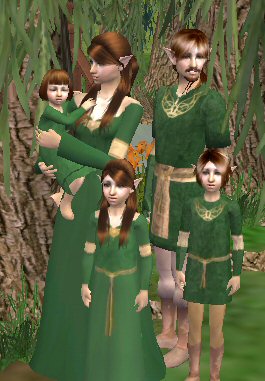
There were seldom more than four elf-children in any one house, and only once more than six. "Their [elvish] families, or houses, were held together by love and deep feeling of kinship in mind and body; and the children needed little governing or teaching". Linguistically, elves said not "I have three children", but "three children have been added unto me", of "are with me", or "are in my house"
Physically, children naturally resemble their parents, but not necessarily spiritually. The child's fea is not derived from the parent's, but is newly made or newly re-born, according to JRRT.
After bearing Feanor, Miriel simply gave up living. "All my strength has gone into him," she claimed, then she gave up living to rest in Lorien. Morgoth's Ring has a full chapter of the Valar debating and arguing at great lengths over this act and what to do about it, since Finwë himself had moaned "Is there no healing in Valinor?"
 It was Nienna who spoke the most tellingly and eloquently, I think, even though she disagreed with Aulë thus:
"the Children are not mighty: in life they are little and can effect little; and they are young and they know Time only. Their minds are as the hands of their babes, little in grasp and even that grasp is yet unfilled. How shall they perceive the ends of deed, or forgo their desires which arise from their very nature, the indwelling spirit in the body, which is their right condition?"She went on longer, but she'd already convinced us that the Noldor of this age, while mature in body and spirit, are still as children as a race. We ainu, who can see farther in the the future, still should not force them to be anything other than what The One made them.
That is, for better or worse, how the Childhood of the Children of Ilúvatar is to be.
Subscribe to:
Posts (Atom)