Saturday, August 11, 2012

A History of Elvish Weaponry, Part 1

JRR Tolkien gives weapons and armor special attention in his books. To clarify, this article ranges a bit larger than simple weaponry, since warfare includes not only the tools and weapons, but defenses, tactics, and natural ability.

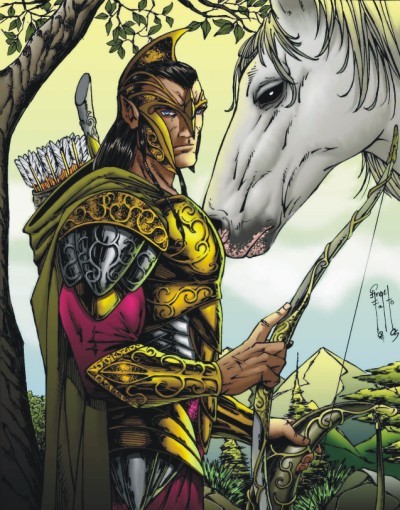
The elves very first tactic for defense was "safety in numbers". To illustrate, the elves' first foes were Melko and his cohorts, and it was hardly fair warfare: Elves were newly created, babes though appearing adult while Melko's forces were mature in their ainu powers and seasoned campaigners, two wars already waged among the aniu. Even at Cuivienen, though, Melko and his minions did not directly attack the elves newly awakened there; they hunted only those who wandered off from the group. Still, while some elves were lost in that first campaign, the far majority survived. Elves, en masse, between their shared wisdom and might, are never defeated. Is there ANY group of elves that lost a battle to another race?  The elves greatest asset is their unity and safety in numbers.

Orome, the Hunter
Granted, the first elve's foes were keeping a low profile at the time because Oromë was on the hunt.
As Melko began corrupting and despoiling the world by creating many unnatural monsters, weapons became necessary, if not preferred, by Oromë, the great hunter. He's recorded as often in Middle-Earth hunting these unnatural abominations with bow, arrow, spear and javelins.Those first weapons are the same as those of Human antiquity.  Archaeologists of the Prehistoric eras claim that humans used wooden clubs, sling and stone, shaped spear, knife, bow and arrow. The elves would have copied and constructed those first weapons on the Great Trek and learned to use them from Oromë himself and each other.

Aulë, the Vala Inventor in Aman would have crafted tools and  weapons that human history records ancient: the hammer, the shield, the staff, the sickle, the chain, the shackle, and the bola. They are only incidentally weapons, firstly being used as agricultural, husbandry, and crafting tools.

Quenya words for weapons of antiquity:
  • Dagger, Knife: sicil (Noldorin Sindarin: sigil
  • Axe:  pelekko, (North Sindarin: hathol, Khuzdul: baruk or burk )
  • Bow quinga, ( Noldorin Sindarin: peng also poetically cû ("arch"))
  • Helmet: cassa, harna, harpa and carma 
  • Shield: turma, umbas (umbaÞ); (Þ is the letter "thorn" with a "th" sound)
  • Spear: hatal and ehte
This would be partial list of names, since elves name everything several ways, including weapons.  Naming and even inscribing names on them is wholly in elvish character. Many elvish and ainu tools and weapons had individual names, especially if the object is meaningful and unique. (Wikipedia List of Middle-earth weapons and armour)

 
ANCIENT WEAPONRY:

This brings elvish warfare into the Ancient era of Earth warfare: bronze then iron sword, shield, helmet, armor, crossbow,

The Silmarillion chapter 7
    when Melkor saw that these lies were smouldering, and that pride and anger were awake among the Noldor, he spoke to them concerning weapons; and in that time the Noldor began the smithying of swords and axes and spears. Shields also they made displaying the tokens of many houses and kindreds that vied one with another; and these only they wore abroad, and of other weapons they did not speak, for each believed that he alone had received the warning. And Fëanor made a secret forge, of which not even Melkor was aware; and there he tempered fell swords for himself and for his sons, and made tall helms with plumes of red. Bitterly did Mahtan rue the day when he taught to the husband of Nerdanel all the lore of metalwork that he had learned of Aulë.
    The passage implies Mahtan taught Feanor to make swords before Melko put the idea in their heads. Thus the swords Noldor elves might bear before Melko is out of prison are the very earliest ones ever made, so sword-craft and technique are new in the Age of the Trees, making instruction classes on sword use and defense especially appropriate.  Noldor invented it.

    it clear that Feanor's "fell swords" are a new invention, but it's highly likely more normal swords already existed.  Fell: (in this sense) destructive, deadly, from Middle English "felon"[wicked], related to "villain", "filet", and "warlock"

    a few other notes about swords: images: http://www.squidoo.com/lord-of-the-rings-swords
    • Sword: makil, macil, (Noldorin Sindarin: crist, magl, magol, North Sindarin magor)
    • Variations: lango (broad sword),  lhang (curved, long two-handed sword for movie Elves)
    •  Armor has no Quenya word, but elves had it.

    The Kinslaying at Algualondë
    Ted Nasmith's fantastic art clearly shows armor, including the red-plumed helms and others in the not-too-distant future, showing Noldor in melee with shields, swords and armor before humanity had awoken.  

    Looking even farther forward in time....
    When Melkor returned to Middle-earth after stealing the Silmarils, his armies attacked the Sindar elves. Those elves were almost totally unprepared, lacking in heavy weapons and suffering heavy casualties but not succumbing.  This event was the beginning of thousands of years on and off warfare against the forces of darkness. The elves or dwarves of Middle-Earth may have been developed some Ancient and Antiquity weaponry independently later, but JRRT makes the high Noldor elves the solution to this imbalance. Here are two quick quotes:

    from -Unfinished Tales, The Disaster of the Gladden Fields. [Of the Dúndain:]
    “They had with the teaching of the Noldor acquired great skill in the forging of swords, of axe-blades, and of spearheads and knives.”

    from -The Silmarillion, Akallabêth [Of the Numenorian]
    "Eönwë came among them and taught them great lore."
    Eonwë is one of the strongest of the Ainu, and a sword master himself, but nowhere is he the inventor of the thing; although he is a herald and messenger, apparently Eonwë learned sword work from the Noldor, mastered it, and passed it on.

    Even Men get armor with Noldor guidance, once both meet in Middle Earth.  Noldor elves continue their innovations in warfare, including other "Ancient" techniques: fortifications, rams and ladders, the war horse and , chariots and war-ships. In later ages, full "medieval" warfare is paralelled in Lord of the Rings: siege towers, ramps, cavalry with lances, infantry formations, plate armor, and the introduction of explosives.

    Fingon and Gothmog,  Ted Nasmith
    But for "here and now", year of the trees 1240, ... the summary is thus:
    we have several hundred years of elvish experience
    with the bow, the arrow, the knife, the stone.
    the javelin and the spear are well known,
    as are healing with herbs and rest.
    Noldor are just leaning the use of swords, armor, and shields. 
    And the first elvish defensive technique: safety in numbers.
    Their shared wisdom and skill is undefeated.


    This was a presentation and discussion of his fictional history of armaments, warfare and tactics as regards JRR Tolkien's works.

    Tirion Forest is a Noldor Elf roleplaying sim, set in the age of the Trees, the noon-time of Aman, when evil is securely bound and the elves and the world are in harmony. Mostly.

    Friday, January 20, 2012

    The Game of Bumps

    Children's games often train skills of coordination and speed. This is "tag", re-invented for Second Life as a simple and fun way to master control of your avatar in active areas.

    BUMPS

    The Basic Rule: When "it" bumps you, you have to bump someone else, then say you did so in chat to make someone the new "it"

    Object: to avoid being bumped by and therefore becoming "it". As "it", to accept the role in chat and then bump another and announce who the new "it" is in chat.

    Equipment: any area roughly 40m across. It need not be utterly clear of obstacles nor fully delineated.

    Players: any number greater than two.

    Preparation

    The group chooses a player to be the first "it". Traditionally, this role belongs to the player who suggests the game or whoever was "it" at the end of the last game.

    The players choose an ending time of the game. All players are prohibited flying in the game.

    Suggested: Each player opens the "Bumps, pushes & hits" window in the "help" menu, so one can see who made contact with oneself, or wears a script that tells when such things happen.

    Optional: Each player can activate a radar or a map, either thru a viewer or a HUD (like Mystitool), so one might see who is close and who is not.

    Playing Bumps

    ~ "It" chats a sentence saying "I am it".
    ~ "It" attempts to physically bump another player by avatar.
    ~ Other players move inside the playing area to avoid "it".

    ~ When "it" actually bumps another, their hit windows will confirm it.
    ~ "It" must chat, by any sentence he chooses, the name of who he bumped within hearing (20m) of the one he bumped.
    ~ Others and "it" may move and repeat that that idea until:

    ~ The one bumped acknowledges "it" in chat.
    ~ He or she becomes the new "it" and play continues as above.

    Ending the game.

    Anyone may, but the person who suggested the game must announce in chat "5 minutes left", "one minute left", "ten seconds left" and "Good Game."
    The last "it" loses the game, but that hardly matters, does it? Now enjoy sharing what happened.

    Irregularities:

    "It" crashing appears to others as "it" disappearing, or going motionless. When this happens, or "it" must leave for a while, the others should gather in the center of the playing area and choose a new "it". Traditionally, "it" is assigned to the one who bumped the crashed "it" or the first "it".

    Being "Out of Bounds" incurs no penalty because it isn't much fun. One should simply return to the playing area directly when discovered out of bounds. One can still bump or be bumped while out of bounds.

    One can quit the game by going out of bounds and stating "not playing" as often as needed, but it is bad manners to re-enter the game after quitting.

    When flying is noticed, the one flying should immediately return straight to the ground with "page down" only. If "it" is under the descending flyer, the bump counts and may be called. If "it" is the flyer, no bumps need be acknowledged until "it" lands and spends 10 seconds motionless.

    Missing chat: One may, if bumped, accept "it" before the old "it" announces one was bumped, but it's better to remind the old "it" he or she needs to announce who was bumped. Handle someone not replying to a chatted bump after several chats as "it" crashing.

    Players joining mid-game can learn the basic rule as they play if others guide them thus: When "it" bumps you, you have to bump someone else, then say you did so in chat to make them the new "it".


    Strategies,
    with links to more complete player guides:

    The real object of the game is to improve the players ability to move, chat, and view the world screen in rapid succession. In more detail:

    To move, use the keyboard arrows (or ASDF if your chat is closed) alone or in combination with shift and/or your mouse. To activate running, use Menu/World/Always Run, or Ctrl-R toggle.

    Views include the default view where you see your avatars back, mouse-look where you see thru the avatars eyes, and custom focus views. Try using mouse-look (activated by mouse-scrolling your view into your avatar's head or pressing M with chat closed) and regular view (activated by escape key or M in mouse-look) and Custom focus. Each one of these might be preferable to you at different times, and each allows different custom options.

    Chatting begins in mouse-look with the Enter key, then type your chat and press Enter again to send. If out of mouse-look, click your chat window, then type your chat and press Enter to send. If you can see another player's name-box floating over their head, they can hear you in regular chat. If the name-box has dimmed to invisibility, they are out of normal chat range, and you must move close to them or send a "shout" (using control-Enter). One can repeat the last thing said with control-up (ctrl-↑) then pressing Enter.

    Game Variations:

    ~Voice can make an easier game if all have voice on and use it instead of chatting who bumped whom and who is it.

    ~Automating bumps would make an easier game if each player wears a scripted object that says bumps in chat, so "it" need not chat the bump. The new "it" must still chat that they are "it" unless all wear a script that keeps track of "it" by chat, float text and/or particle emission.

    ~RSVP: whenever anyone chats your name (or a reasonable facsimile thereof) in your hearing, by itself or in a sentence, you must immediately chat a reply. This will leave you unable to move until you have completed your chat, and vulnerable to bumps.

    ~No tag backs, where "it" may not bump the person who bumped him or her, works best in a group larger than five.

    ~No running creates a slower-paced game; shrink the playing area to 25x25.

    ~Flying, when allowed and encouraged, is best played in a thick 40x40x40 box.

    ~ Rezzing. For an advanced group, encourage players to rez barriers in the playing area. Owners of the items may move, delete or change their own barriers at any time, of course. Simplest to allow only creating and editing non-scripted, non-physical default prims during the game, but the group may choose to allow anything, including scripted or physical items to appear and disappear.

    Have Fun

    Fair warning: in many areas, bumping another avatar might be grounds for a complaint to the management. Don't play Bumps in busy, public areas where non-players may get you in trouble.

    Saturday, January 14, 2012

    Fan Fiction Links

    The lovely poem spoke to me especially since I have the huge honor of role-playing Aule in Second-Life "Tirion Forest" and nearby areas for the last several years. The image is very similar to a scene I and my Yavanna played many months ago, but written infinitely more eloquently.

    With the Larner's permission, I mirror


    He found her singing in the darkness beneath Varda's stars, and he smiled. Of green things she sang, of trees and grass and scented flowers.

    He entered the clearing, adding his song to hers, singing of rich soil and shining minerals, soft sand and smooth stones.

    He could tell she was glad he had joined her, for now she began to sway as she sang of blossoms and fruit.

    He stepped to the side, singing of clay and mineral-laden water, heated by the earth and given to the relief of aching joints and exhaustion.

    She sang of the sweetness of apples.

    He sang of the richness of cups made from the metals to be taken from the earth, and how they would be ready to hold the apple's juices. Their hands met as their steps began to complement one another's.

    She sang of the song of crickets hidden under leaves, of the song of frogs beside the banks of streams.

    He sang of the song of the water as it poured over rocks and between boulders. They circled one another in their dance.

    She sang of filled bellies and contented children.

    He sang of useful items made such as knives to peel fruit and prepare vegetables to be eaten.

    He lifted her easily high into the air, and she laughed as she sang of the comfort of growing things.

    He responded with the reassurance of the reliability of the earth and its bones. He set her upon her feet.

    She paused, then held out her hands to him, her song slowed and seductive as she sang to him of the thanksgiving offered by trees and plants for the earth from which they grew.

    He took her hands and drew her to him, singing of the consummation the earth could know only when growing things sprang from it and drew from its bounty.

    He inclined his head, and she raised her face to meet his, and as Yavanna kissed her beloved Aulë their joined songs continued, more full and harmonious for their shared love and delight in one another.

    And all of the world prepared for the Children of Iluvatar delighted in their shared dance.

    Tuesday, December 6, 2011

    Name the Bad Guy Entries.

    A handful of entrants gave multiple entries to "Name the Bad Guy"

    Our Elven RP leader, Maralee Greenwood, teaches that The Silmarillion states that the Noldor do not speak Melkor's name and that JRRT wrote "The Fallen One" for them to use instead. Quoting Valaquenta, "Of The Enemies":
    "Last of all is set the name of Melkor, He who arises in Might. But that name he as forfeited; and the Noldor, who among the Elves suffered most from his malice, will not utter it, and they name him Morgoth, the Dark Enemy of the World."
    This could justify the Noldor calling the bad guy Morgoth from the very beginning. Since the Noldor had not suffered anything unusual of his malice by the Noontide of Valinor, we play that the elves call The Bad Guy neither "Melkor" for fear of the power of the name, nor "Morgoth" for it hasn't been coined yet.

    The phrase "Fallen One" never appears in Tolkien's the Silmarillion. The word "fallen" appears less than 20 times, and never in reference to Melkor. Still, the elves might indeed use "Fallen One" as the Quenya lantë (a moral fall) suggests "Lantwë". Of the Ainu, though, only Aulë claims "I have fallen into folly" in his chapter. Hearing the useful "Fallen" or "Lantwë" would make Aulë, fallen yet forgiven, regretful.

    The Entries:
    • ~ "Lantwë", Quenya for "The Fallen One"
    • ~ "Límilawë" for "The Chained One"
    • ~ "i túra nancar" for "The great destroyer"
    • ~ "Morier" for Dark One,
    • ~ "Feuyaer" for the disgusting one
    • ~ "Ksher" for the Evil one
    • ~ "Oklem" or "Roklem" are Melko and Melkor backwards, so as to mimick his feature that he never did anything on this own but only corrupted and distorted what others had made before, so we do not give him a "new" name but rather take the "old" one and corrupt it ourselves.
    the entrants did not attempt to translate these last into Quenya, but I did:

    • ~ "First of tyrants", Quenya has no word for tyrant. Perhaps "First Night Lord", or "First Slave Lord" will do: Lómëheru-minya or Mólheru-minya
    • ~ "Sourvoice", as stink- holwë + voice óma = "Holoma"
    • ~ "Badsong" as bad Olca + song linde = "Olcalin"
    • ~ "Shouty" or "Shouter" as "Ramando"
    • ~ "The Discordant" deserves some thought:
    in JJRT's Ainulindale, other words appear for the Bad Guy once each: "loud", "vain", "clamorous" "braying" "disturbed" "turbulent" "uproar". Three times the word "discord" describes what the Bad Guy makes:
    Dis-cord
    ~Lack of agreement among persons, groups, or things.
    ~Tension or strife resulting from a lack of agreement;
    ~strife, dispute, war, dissension.
    ~confused, harsh or inharmonious sound or sounds.
    ~a dissonance in music.
    ~To fail to agree or harmonize;
    ~clash.
    "Discord" isn't in Quenya wordlists, nor most above, but these are:

    "NOT" ú-, in-, un-, prefix usually has a "bad" connotation
    MUSICAL SOUND lin, lind-, linda
    PEACE sérë, rainë, sívë;

    suggesting "Úlin", "Úlin", "Úlinda", "Úsérë", "Úrainë", and "Úsívë".

    The etymological roots of discord offer another direction:
    [Middle English, from Old French descorde, from Latin discordia, from discors, discord-, disagreeing : dis-, apart; see dis- + cor, cord-, heart; see kerd- in Indo-European roots.]
    HEART hón (physical heart), órë (inner mind), indo (mind, mood), enda (centre, soul or mind), elwen (is early “Qenya”).
    BREAK APART terhat-; hat- ; ascat-

    suggests: "Hatórë", "Hatenda"

    Judging

    JRRT's own names that the Noontide elves called The Bad Guy could fit our needs nicely "The Hunter" ("Roimë" in Quenya), "The Dark Rider", ("Moroquen") and "Dark Hunter" ("Moroimë"), even if all are similar to "Oromë".

    Top prizes go to "Lantwë" (Fallen One), "Morier" (Dark One), and "Roklem" (arising in might backwards) for whimsey, style and brevity. Honorable mention goes to "The Discordant", translated as "Úlin", "Úrainë" or "Hatórë".

    I'd like to make one entry myself, obvious yet overlooked:
    "The Bad Guy
    ": "Olcawë", or better, "Úwë".

    The Noldor of Tirion in Second Life will soon get ALL these entries and the JRRT to use as they wish. I will take a survey among them after March 14 regarding which of these names actually get used and award another prize at that time.


    Thursday, December 1, 2011

    JRRT Names the Bad Guy

    In preparing to award contest entry prizes, first a review of JRRT's words about him are in order. The interesting Tolkien Gateway site about Melko lists many names. Only some of them might have been used in the "Noontide of Valinor".

    "Melkórë", "Melko", "Melegor", and "Meleko" are apparently Valarin, (spoken by the ainu) Eldarin, (spoken by the first elves) or Quenya (spoken by our Noldor Elves of Aman) names that Tolkien used in drafts, before he settled on the Quenya "Melkor" translated in the Silmarillion as “He who arises in might". These are likely related to the little used Eldarin (possibly Valarin) name "mbelekôro".

    The early elves of Cuiviénen called him "The Hunter" ("Roimë" in Quenya) and "The Dark Rider", ("Moroquen"). There is a non-Silmarillion reference to "Dark Hunter" ("Moroimë") but not in this defining passage:
    "if any of the Elves strayed far abroad, alone or few together, they would often vanish, and never return; and the Quendi [elves] said that the Hunter had caught them, and they were afraid. And indeed the most ancient songs of the Elves, of which echoes are remembered still in the West, tell of the shadow-shapes that walked in the hills above Cuiviénen, or would pass suddenly over the stars; and of the dark Rider upon his wild horse that pursued those that wandered to take them and devour them."
    "The Enemy" and "Great Enemy" are used thru time for the Bad Guy, but also for his chief in Middle-Earth, Sauron. Word lists render these as "Cotumo" and "Altacotumo"


    Feanor once calls the mightiest of all the dwellers in Eä "jail-crow of Mandos", but his name-calling doesn't stick until the darkening of Valinor and his father's murder:
    "Fëanor rose, and lifting up his hand before Manwë he cursed Melkor, naming him Morgoth, the Black Foe of the World; and by that name only was he known to the Eldar ever after."
    JRRT considered but set aside "Moriñgotho", "Moringotto" and "Moricotto" for "The Dark Enemy" here. The Sindarin "Bauglir", meaning "The Constrainer" appears the Silmarillion often but only as "Morgoth Bauglir".

    Also in Sindarin, the elven language of Middle-Earth, are "Belegûr" for "He who arises in might" and "Belegurth" for "Great Death". "Belcha" is not used in Silmarillion, but others have ascribed it to a Sindarin dictionary. It's clearly not Eldarin nor Quenya nor Valarin, since none of those use an initial letter B.

    Humans in later ages added "Dark Lord", "Dark King", "Dark King of Angband", "Black King" and "Lord of the Dark" to our antagonist's monikers.

    The Bad Guy even gives himself a few titles. When speaking to Noldor, he calls himself "Vala" also, and "friend to the Noldor". When speaking to to Húrin, he claims "Master of the fates of Arda" (rightly belonging to Námo Mandos) and "Elder King", which was accurate in the brief time the Bad Guy was the only sentient creature in the World, until the arrival of meritous Manwë.

    Fittingly, the Bad Guy gets exiled the last paragraph of the Silmarillion (emphases mine):
    the Valar thrust [Morgoth himself ] through the Door of Night beyond the Walls of the World, into the Timeless Void; and a guard is set for ever on those walls, and Eärendil keeps watch upon the ramparts of the sky. Yet the lies that Melkor, the mighty and accursed, Morgoth Bauglir, the Power of Terror and of Hate, sowed in the hearts of Elves and Men are a seed that does not die and cannot be destroyed; and ever and anon it sprouts anew, and will bear dark fruit even unto the latest days.

    Here ends the SILMARILLION.

    Name the Bad Guy Contest

    Arth Karas here, not quite fully in character as Aulë

    Melko has many names in later Ages, but few in the Age of the Trees. As you can see in the chat below, the ones we have are a bit unwieldy or being avoided. Thus, we need a unique and appropriate name to call him.

    NAME THE BAD GUY CONTEST

    Acceptable names will be:
    ~ Either chosen or translated directly from JRRT Tolkien sources
    ~ rooted in Quenya or Valarin or English, since Sindarin, Latin and other such languages are unknown yet in our RP.
    ~ clearly not some other character nor confusingly similar to such
    ~ accurate to Melko's character
    ~ not overly respectful (for reasons of story arcs to come)

    Please look over what I have here and send me names by SL IM, which forwards to arth.karas@-at-gmail.-dot-com. Multiple submissions accepted. I will choose the acceptable submissions (and likely write an article here about which and why) based on creativity, originality, duplication and whimsy. After entries are collected thru Jan 1, 2012, I will split a L$ 1200 entry prize among to Sheriwood and ~Aglarond~ group members. All accepted suggestions will go to Noldor Elves of Tirion to use in role play. From their natural selection by use, I will choose a grand prize winner of another L$ 600 by March 4, 2012.

    Learn more:

    http://tolkiengateway.net/wiki/Morgoth
    http://en.wikipedia.org/wiki/Melkor
    http://aulethesmith.blogspot.com/2010/09/aule-versus-melkor.html
    http://users.bestweb.net/~jfgm/valaquenta/texts/21%20Melkor.htm

    Open Chat excerpt prompting this contest:
    Second Life, Tirion Forest Sim 01Dec2011 ~ 1400 PST
    During a 3 player discussion on Melko's character.

    Marwen: The One's mind has turned so bad
    Aulë: WHAT?
    Marwen: this cannot be a mere coincidence
    Aulë is agitated. WHAT ARE YOU SAYING?
    Anairë: The evil one do you mean?
    Marwen: My lord
    Aulë mimics Marwen: The One's mind has turned so bad
    Marwen: forgive me Mylord
    Marwen: my wording is poor indeed
    Aulë: THE ONE is Eru, Ilúvatar.
    Aulë: WHAT DID YOU THINK YOU MEANT?
    Marwen: The Fallen One
    Aulë: pfff.
    Aulë: Just call him Melko.
    Aulë: Melkor.
    Aulë: he's not "fallen" any more than I am.
    Marwen: we are not supposed to say his name
    Marwen: that's why
    Anairë: Lady Yavanna suggested we not name him?
    Aulë stammers a moment.
    Marwen looks down ashamed
    Anairë: You may be safe from his attention Vala Aule...but if we came to his special notice
    Aulë: composes himself.
    Aulë: Your respect of the Lady Yavanna's suggestions are wholly commendable. I'm proud of you.
    Aulë: and I see her point... and yours.
    Anairë: We are a little more vulnerable than you are Vala Aule...smiles
    Aulë: I'm already Melko's target for mischief.
    Aulë: aye... and your keeping a low profile makes sense.
    Anairë: Oh he has caused you harm?
    Aulë waves aside the question impatiently...
    Aulë: but when the names you chose to use infect your very speech and ideation to say such silly things as I just heard...
    Aulë: you need to choose another solution.
    Anairë: nods
    Marwen: we learned at the last barding his name among the Noldor is "The Fallen One"
    Aulë: might I suggest something less similar to Eru's name?
    Anairë: mmm thinks of a name
    Aulë: in my own though, he is often "HotHead"
    Aulë: and lately... "Chained"
    Anairë: He who is chained would not be mistaken
    Anairë: Well unless any Noldor are taken and chained.... shudders
    Marwen: and you made the chains
    Aulë: aye. I made them special just for him. Fire is my domain as well among the Vala now.
    Marwen: so it would be your domain to make an exception here too
    Aulë: I have no objections to naming Melko after chains or fire. They are his more than mine.
    Aulë: Perhaps I should host a contest...
    Marwen: this would leave us at "the chained one"
    Anairë: What aspect was he who is chained supposed to have dominance over if the song was perfect?
    Marwen: deliberately without capital letters
    Aulë: Melko is an aspect of extremes: very hot, very cold, very beautiful, very abhorrent.
    Aulë: and he has great gifts in all areas of creation.
    Aulë: "what to name Melko, when you must speak of him"
    Aulë: yes.... I think I will do that. Sponsor a creative contest to find names for that character...
    Anairë: Evil seems a good description of him
    Anairë: but there are many names for such an evil one
    Aulë: names that are at once accurate, yet not overly respectful.
    Aulë hums in thought, taking up quill and scroll.

    Saturday, October 29, 2011

    Relative Quenya Names

    This in Aulë's Second Life In-box:

    hello

    I think you are the language expert in Tirion and I was wondering if you could tell me the correct forms of address for family members as my friend and I are playing aunt and neice. Do you know what the Quenya elvish for these are?

    Also mother, father, brother, sister, and if possible, grandparents?

    We've been using English terms, but they jar a bit in Tirion. I think the Quenya would be more resonant :)

    Thankyou!
    Iminwiel

    Allasár, Mellonin! (Blessings, girlfriend!)

    My favorite source for researching such questions is the website Ardalambion

    In the downloaded Quenya files, I use "find" to locate my words of interest:
    ~~aunt.... not found ...
    ~~niece... not found ....
    Failing there, I look up related words and educe the words we want: aunt = parent's sister. niece = siblings's daughter
    ~~PARENT #nostar (pl nostari) or ontan (pl ontani) ; also father ontaro; mother: ontarë or ontari .
    ~~'s is possesive: -rya (possessive suffix, e.g. aratarya "her sublimity". for all genders . words ending in a consonant take the shorter form -ya, e.g. talya “his foot”,
    ~~SISTER nésa (þ; older form néþa), colloquially also nettë (probably netti-); also "sister" seler (Þ) (pl. selli), onómë, onónë; SISTER (usually not of bloodkinship) osellë (Þ)

    so,
    ~~AUNT: parent's sister: nostar+rya+nésa, shortens to nénostárya. less formal: nettë-ontar-rya, shortens to nettontarya. even shorter, "nettarya".

    That is still a bit of a un-resonant mouthful. Maybe something prettier will show up with more searching.

    ~~sibling... not found. But I have sister, so.
    ~~BROTHER háno, colloquial hanno . also toron (pl. torni) (= natural brother); cf. otorno "sworn brother, associate".
    ~~DAUGHTER selyë; also yendë, yen, yeldë, suffixes: –iel (e.g. Uinéniel "daughter of Uinen") obsolete: -wen, -yel.

    so
    ~~NIECE is either sister's daughter: nésiel, nettiel , seleriel or onómiel .... or brother's daughter: hanniel, hánoyel, toroniel
    Noldor elves in our early RP age would use archaic forms.: néþyel ( Néthyel) or toroniel. I like those.

    You can easily find the other words in the pages above, except for grandparent:
    ~~ Grand not found except grandchild. After poking around, I find.
    ~~DOUBLE (prob. adj) atwa, tanta; DOUBLE (vb) tatya- (repeat). (Note: tatya also means "second".) –AT(AT), TATA

    This "tatya" is especially apt: the First of the Noldor clan to awaken was named Tata. Then consider AUNT in spanish or french is tanta or tante.

    So
    ~~GRANDMOTHER: tatya-amillië -> tatamillië.
    and
    ~~AUNT = grandmother's daughter: tantamilier. Even simpler:
    ~~AUNT = second mama: tatyamil.

    That resonates.

    Love, Arth.